
The Natural Resources Institute Finland (Luke), in cooperation with EAA member Finnish Recreational Fishermen’s Association (FFRF), has published a recent study showing the main motivations of angling women, concluding they spend less time fishing than men, tend to favour rods and passive gear more often, and that the number of girls participating in fishing is declining.
Central research question: What motivates you to fish?
The newly published study was based on national data collected by Luke in different years. The most recent of these was from 2025, based on the responses of nearly 4,000 women who had paid the fisheries management fee and about 650 men (included for comparison purposes).
According to the scientific results, Finnish women are a diverse group of different recreational fishermen in terms of fishing background and experience, habits and activity.
“The motivation of recreational fishermen to fish is generally quite similar to that of other nature activities. Time spent with the family, enjoying nature and recovering from stress are significant motivational factors for women who fish – and relatively rarely, for example, large fish,” says Jani Pellikka, Senior Scientist at Luke.
Typically, women feel that fishing is a fairly important hobby. However, the difference between the sexes is, for example, that among women there are more often those who consider fishing to be their occasional hobby and less often those for whom it is the most important hobby.
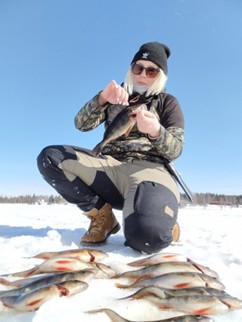
Participation patterns across generations
According to Luke’s study, 77% of women who fished lived in households where men also fished. Fishing is socialized as a child, but more and more women start in adulthood.
Also, “Fishing by girls aged 10 or over seems to be decreasing in Finland, and the proportion of women who started fishing as adults is gradually increasing. There is a big difference between the genders,” Pellikka says.
Several methods have been applied in Finland for a long time to increase women’s participation in fishing. The Finnish Recreational Fishermen’s Association has implemented the Mimmit kalastaa (mimmitkalastaa.fi) project. With this project, FFRF has organised open and free fishing events in different parts of Finland, especially for women and girls. At the events, participants can try fishing under guidance without previous experience or their own equipment.
The instructors provide advice on the use of equipment, fish handling and responsible fishing, and at the same time build a communal and encouraging atmosphere
“Many people come to our events for the first time in their lives to try fishing. When the equipment and guidance are available on site, the threshold for participation is significantly lowered. It’s great to see how quickly uncertainty turns into enthusiasm and experiences of success,” says Tintti Drake, Communications Coordinator and leader of the Mimmit kalastaa project.
The high number of women who raise barriers to fishing suggests that there may be a demand for targeted support, especially for those who are just starting out in fishing or who are doing it occasionally.
“Not everyone needs support, nor does it need gender emphasising in fishing in general. However, attention could be paid especially to girls’ fishing and, for example, to low-threshold fishing opportunities and offering them positive role models. The participation of women is also supported by family-friendly and easily accessible fishing destinations. Guidance and peer support can also benefit those who start as adults,” Pellikka sums up.
Women in recreational fisheries: growing awareness and targeted initiatives across Europe
Women are increasingly recognised as an important part of the recreational fishing community. A trend that has gained traction not only within angling networks but also in broader public and policy discussions.
EAA and its members have frequently reported on initiatives aimed at supporting and expanding women’s participation in angling.
Notably, a recent European Parliament Think Tank publication (October 2025) includes a dedicated segment on women in recreational fisheries. This study underlines the relevance of gender inclusion in discussions on participation, sustainability and the socio-economic value of the sector.
This increasing visibility confirms that women’s engagement in angling is no longer a marginal topic, but part of a broader European conversation on access, diversity and the future development of recreational fisheries.
Sources & further reading
- FFRF press release: Women are particularly motivated to fish by enjoying nature and recovering from stress, according to a recent study – Leisure Fishermen
- LUKE study file: Naiset vapaa-ajankalastajina : Tutkimus
- EAA Finland promotes recreational fishing by women through the Mimmit Kalastaa project – EAA Europe
- Mimmit kalastaa project by FFRF: Etusivu – Mimmit kalastaa
- Analysis by EU Parliament on women in fisheries (2025) – Research for PECH Committee – Women in fisheries – State of play and progress on gender equity in the EU | Think Tank | European Parliament


