On Friday 13 February, the Sportvisunie, together with three ministries, the Union of Water Boards and the European Fishing Tackle & Trade Associationtion (EFTTA), concluded the Cooperation Agreement for Lead-Free Sport Fishing 2026-2029. This agreement contains joint agreements and actions to encourage lead-free fishing – in anticipation of a European ban on fishing lead.
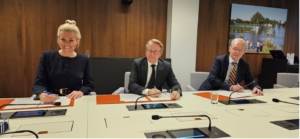
From left to right: Piëtte van Hoorn (Sportvisunie), Robert Tieman (Minister of Infrastructure and Water Management) and Jean Rummenie (State Secretary for Agriculture, Fisheries, Food Security and Nature).
© David Vertegaal – 2026
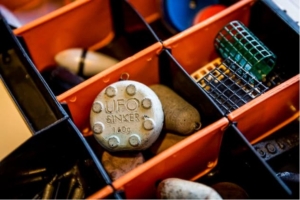
The cooperation agreement contains all kinds of agreements and measures for a faster transition to lead-free sport fishing. The agreements are mainly intended to encourage even more anglers to use lead alternatives. For example, through pilots and projects on lead-free fishing. To prevent the reduction of sport fishing lead from leading to a ‘switch’ to other hazardous substances for human health and the environment, the signatories will promote and encourage safe alternative materials such as iron, concrete, stone, glass and tungsten. Unsafe alternatives such as zinc and copper are actively discouraged.
Minister Robert Tieman (Infrastructure and Water Management): “With this agreement, we ensure that less fishing lead ends up in the water. I think it’s great that we are taking up that gauntlet together, because in the end we all want the water to be cleaner. Compliments to the Sportvisunie and the EFFTA: together we show that tackling at the source is really possible.”
Previous efforts successful
Piëtte van Hoorn, who signed the agreement as deputy director of the Sportvisunie, explains that the agreement is not an isolated one. “The agreements in the document fit in seamlessly with our previous efforts to gradually achieve lead-free sport fishing. With the Green Deal Lead-Free Sport Fishing and the subsequent Lead-Free Sports Fishing Cooperation Agreement, we have been working since 2018 to raise awareness of the risks associated with lead use and to change the behaviour of anglers. With result: the use of lead substitutes increased from 2% to 14% in freshwater and from 6% to 19% in saltwater between 2018 and 2023. The number of anglers who fished with a lead substitute annually rose from 116,000 in 2017 to 311,000 in 2021. The agreement should help to continue this line.”
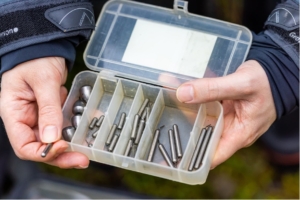
Steel and tungsten weights are becoming increasingly popular among predatory anglers. They are not only more sustainable, but also offer several technical advantages over lead in terms of fishing performance.
© Sportvisunie
European approach with support from EFFTA
Van Hoorn states that the total package of agreements and measures in SWOK is well put together for anglers and the entire angling industry. “For the Sportvisunie, it is especially important that the approach is aimed at a European ban. There were already plans for a national ban on the sale of fishing lead in 2025, but we managed to counter that together with the EFFTA. Such a ban would not have been verifiable and disproportionately harmful to Dutch trade. We are pleased to have the EFFTA on board as a co-signatory. Support and cooperation from all European producers and traders in fishing lead is essential for the further development of sufficiently affordable lead alternatives – and thus for the transition to lead-free sport fishing to succeed.”
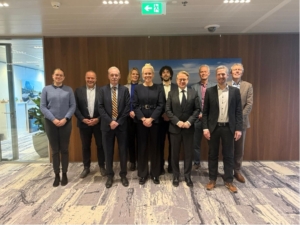
Together for lead-free sport fishing: representatives of sport fishing, government and partners during the meeting.
Real transition period
When exactly there will be a total fishing lead ban in Europe, Van Hoorn finds it difficult to estimate. But that it will happen, she says, is certain. “We also support the arrival of such a ban, because lead is demonstrably harmful to public health and the environment. But it must be done in a realistic and feasible way. That is why, together with the SWOK partners at the European level, we have worked hard for a transition period of three to five years. That phase will only start as soon as EU member states agree on a ban. Anglers, producers and traders can then prepare for a few more years. As Sportvisunie, we have strongly advocated for this. In this way, we can be sure that there will be plenty of good alternatives available for all disciplines within sport fishing,” Van Hoorn emphasizes.
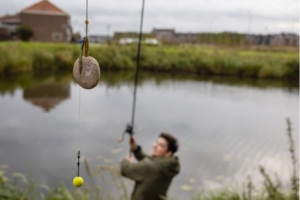
A stone casting weight is – just like variants made of iron, concrete, glass and tungsten (tungsten) – a safe alternative to lead.
© Sportvisunie
Lead – a hazardous heavy metal for both human & nature
- Lead is a heavy metal and a hazardous substance. While widely used for decades in fishing weights and sinkers, many anglers are not fully aware of its potential health impacts. Scientific evidence on the harmful effects of lead exposure continues to grow.
- Importantly, there is no safe level of lead exposure. Even very low concentrations of lead in the bloodstream can have adverse effects.
- In a recreational fisheries context, exposure can take place in several ways. Anglers who cast their own lead weights may inhale fumes during the melting process. Small split-shot weights are sometimes crimped onto the line using the teeth, creating a direct ingestion risk. Accidental swallowing of small lead components is another possible pathway.
- Beyond human health considerations, lead sinkers and weights lost during fishing activities can accumulate in aquatic environments, posing risks to wildlife and potentially affecting water quality. Reducing these emissions contributes directly to healthier ecosystems, improved biodiversity and safer habitats for flora and fauna.
© Sportvisunie
Sources & further reading:
- Source: Loodvrije sportvisserij: Europese aanpak en ambitieuze samenwerking | De Sportvisunie
- https://www.linkedin.com/posts/sportvisunie_loodvrij-sportvisserij-duurzaamheid-activity-7428100144203530240-kEfW?utm_source=share&utm_medium=member_desktop&rcm=ACoAADoJhEoBSgdD5rJlfJyLG9IDi0qdwfhi8sc
- Loodvrij sportvissen: info, alternatieven en beleid | De Sportvisunie