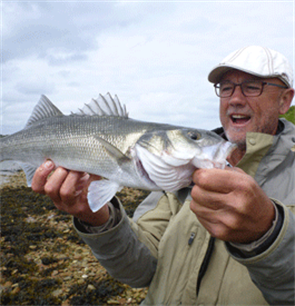
Artisanal (commercial) hook & line fishers will be limited to 10 tonnes per vessel per year (compared with 1.3 tonnes per month in ten months of 2016) while recreational landings will be limited to 10 bass per month (compared to 1 fish per day from July-December 2016).
A closed season will apply in February and March in order to protect spawning aggregations of bass – a measure needed because the spawning stock biomass has reached critically low levels. Catch and release angling will be allowed in these months.
The Commission has maintained a 1 per cent bycatch allowance for demersal trawls and seines but included a cap of up to 1 tonne per month in addition for 2017.
EAA is disappointed that the Commission’s proposals did not include extending the measures to the southern stock which may now see increased fishing pressure due to displacement of those fishing with trawls and nets from the northern to the southern Regions where the Commission’s proposed measures would not apply. In order to prevent a repeat of the northern bas stock decline EAA believes the precautionary approach should be applied in the absence of more evidence about the status of southern bass stocks. This should include raising the minimum conservation reference size to 42cm; a measure which was applied to northern bass in 2015.
EAA is pleased that the Commission has seen fit to not increase the bycatch allowance for demersal trawl and seine fisheries which would have done nothing to reduce fishing mortality. EAA believes that further effort must be directed at increasing selectivity and avoidance measures for these fisheries. Hook and line fishing is highly selective with high rates of survival of fish returned to sea. Management can therefore be fine-tuned with measures to further increase the spawning stock such as the introduction of a higher minimum conservation reference size and a maximum size which would protect the fecund ‘super-spawners’.
EAA supports the closure of all fishing to protect spawning aggregations of bass on the condition that the measure applies equally to all stakeholders. However, last year saw the Commission’s proposal for a six-month moratorium for all forms of fishing watered down with exemptions granted for hook & line and fixed nets. It will be unacceptable for the European Council to increase fishing mortality in 2017 by granting similar exemptions.
David Mitchell, Chairman of the EAA Sea Sub-Group, said: “The Commission’s proposals for bass should be welcomed by the hundreds of thousands of anglers who represent those members of society who fish recreationally for publicly-owned sea bass and will get a fairer deal with the monthly bag limit EAA has been arguing in favour of for some time now. There’s no room for nets in the fishery in 2017 given the contribution they have made driving the stock to its lowest recorded level.
The Council of Ministers must now back the Commission’s proposals and avoid a repeat of last year’s disastrous negotiations which failed to reduce fishing mortality sufficiently as well as being roundly unpopular with both commercial and recreational fishers”.
Jan Kappel, EAA Secretary General, said: “A slow growing, late maturing, fish like bass is unfit for that kind of free large scale commercial fishing, which took off in the 1970s and was allowed to continue until the stock was severely depleted. Ireland banned commercial fishing for bass in 1990 due to depletion of the stock. This was a stark warning to other countries but was ignored. We are confident that the management measures for last year, this year and 2017, and the long term management plan to come, will turn the tide – but don’t throw the baby out with the bath water, please! Our sector was hit very hard this year, and needs ‘more air’ next year.”