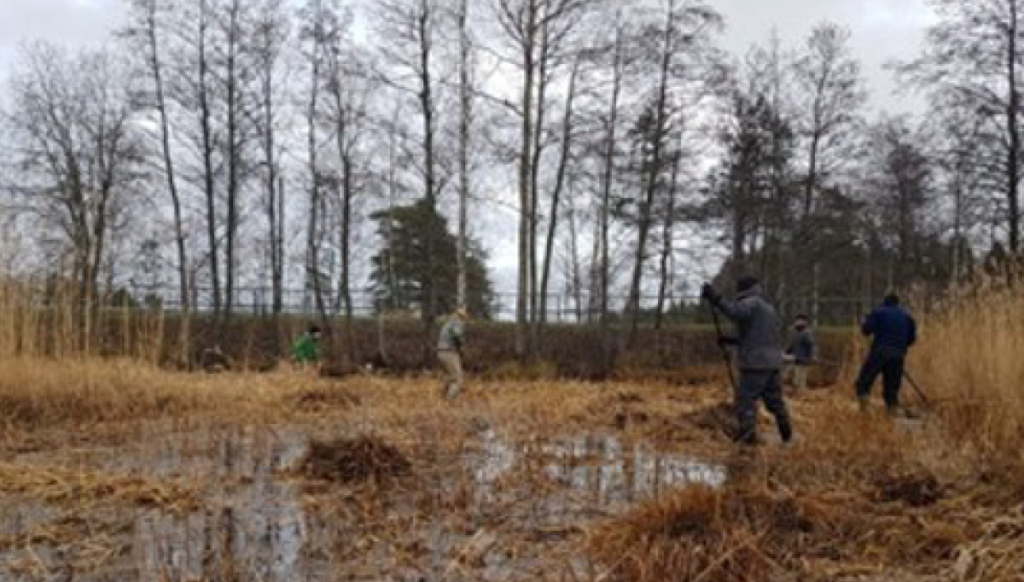
Wild salmon once disappeared from Sweden’s Testeboån River. Today, after years of restoration work, they are reproducing naturally again – and a new court ruling could give them better conditions to thrive. The decision introduces stronger environmental requirements for the Strömsbro hydropower plant, including longer turbine shutdowns during migration periods, higher minimum water flows and better protection for young salmon heading to sea.
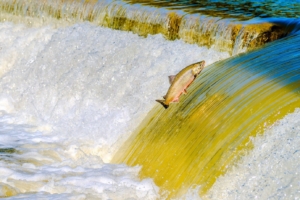
New conditions to improve salmon migration
After a long legal process, the court has decided which environmental conditions will apply to Strömsbro power plant, the first power plant encountered by fish migrating upstream from sea in the Testeboån river. The ruling introduces, among other things, several important measures to improve fish migration. The power plant will not be allowed to be in operation during July and August. It will also remain idle for two consecutive days a week during June and during the period 1 September–15 October, giving salmon and other migratory fish better opportunities to move through the river.
The judgment also requires the power plant owner to implement measures that ensure that at least 95% of the downstream migrating salmon smolt is diverted and thus prevented from entering the power plant’s intake channel.
At the same time, the minimum discharge at the power plant will also be significantly increased and will amount to at least 2.9 cubic metres of water per second, which will provide better conditions for fish and other aquatic organisms to be able to pass through the power plant.
Thomas Lindblad Wieslander, General Counsel at EAA member Sportfiskarna, highlighted the importance of the ruling:
“The court has particularly emphasized the importance of salmon reproduction in Testeboån, but also that the river is part of a Natura 2000 area where the freshwater pearl mussel is a specially designated species. The court also points out that Testeboån is classified as a wild salmon lake and designated as an index watercourse for salmon,”
Overall, EAA member Sportfiskarna considers the new conditions an important improvement for salmon and sea trout.
“In essence, the judgment means that the conditions for viable stocks of salmon and sea trout increase significantly. But the last word may not have been said yet, as the power plant owner chose to appeal the ruling. Sportfiskarna will continue to follow this and other reassessments in Testeboån.”
A river where salmon have successfully returned
The Testeboån is particularly important because its original salmon population had previously disappeared.
“Following many years of conservation and restoration work, salmon were successfully reintroduced. Today, the river once again supports a self-reproducing wild salmon population and is officially recognised as a wild salmon river by the ICES Working Group on Baltic Salmon and Trout (WGBAST)” – writes Glenn Douglas, Project Manager Salmon at Sportfiskarna.
The river also has significant wider conservation value. The Testeboån river is designated under the EU’s Natura 2000 network, and the river supports freshwater pearl mussels.
The Strömsbro ruling is part of a broader legal proceedings concerning hydropower operations along the Testeboån. Decisions have also been issued for four other upstream power plants (e.g. Bosgården and Strömsborg), all of which are currently under appeal & pending before the Land and Environment Court of Appeal. Sportfiskarna continues to argue for fish passage solutions that also work for larger migrating fish, incl. fish over 1m length.
Why the Testeboån court ruling matters beyond Sweden
The Testeboån case is a positive example of how stronger environmental conditions for existing hydropower infrastructure can support the recovery of migratory fish.
For salmon, river connectivity is particularly important. Fish must be able to reach suitable spawning grounds upstream, while young smolts need safe downstream passage on their journey towards the sea. Adequate water flows are equally essential for maintaining functioning river habitats.
Restoring salmon also brings benefits beyond biodiversity. Healthy salmon rivers are part of local cultural identity and can support recreational fishing, tourism and local economies. In Sweden alone, recreational salmon fishing generates around €11 million annually on the Torne River and €4.5 million on the Mörrum River. In Finland, the value of a single salmon caught by recreational fishers at sea has been estimated at €1,150. Protecting salmon and their habitats, alongside proper fisheries management, can therefore deliver environmental, social and economic value for communities across Europe – as highlighted by EAA at the European Parliament in November 2025 (LINK).
Links & further reading
- Original source: New environmental conditions strengthen salmon in Testeboån – Sportfiskarna
- EAA adopts 2 new position papers on recreational fishing for Western Baltic cod and Atlantic Salmon in Baltic Sea for 2027 – EAA Europe
- PRESS RELEASE – Losing more than fish: EU recreational fishers rise as wild salmon vanishes – EAA Europe
- The world’s salmon are at risk. A major International Conference tried to find out Why! – EAA Europe
- A Special Year for a Special Fish: The lnternational Year of the Salmon has started! – EAA Europe
- Baltic salmon – A resource for the future – EAA Europe
- Broad agreement on more fishways – but who will pay? – Anglers — article on the subject by Sportfiskarna