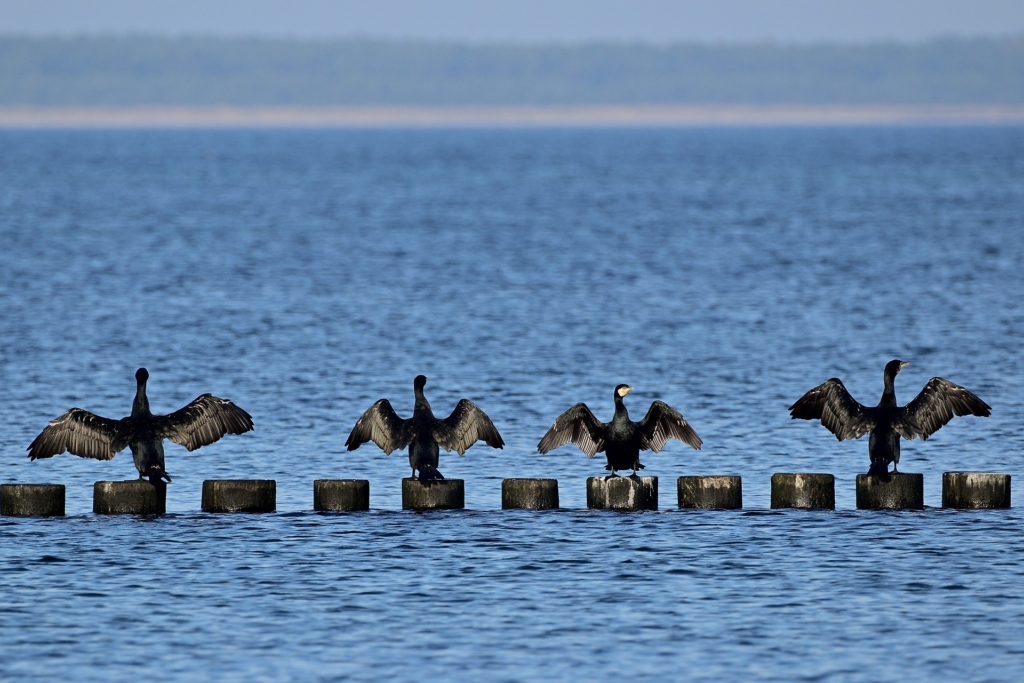
On 26 May 2026, EU Fisheries and Agriculture Ministers met in Brussels for the AGRIFISH Council, where ministers discussed an AOB agenda item – proposed by the Czech Republic – on the growing impacts of fish-eating predators, in particular the great cormorant.
Growing concern across Europe
The discussion was initiated by the Czech Republic and supported by Croatia, Estonia, Finland, Latvia, Poland, Romania, Slovakia and Sweden.
Ahead of the AgriFish Council meeting, the Czech Republic delegation shared an “information note” sustaining their proposal for AOB-item. In the document – supported by 8 other EU Member States – states that
“the annual fish consumption of an adult great cormorant is estimated at around 180 kg”, and “with an estimated population of approximately 2 million individuals, the total annual fish consumption by cormorants in Europe thus reaches roughly 360,000 tonnes”.
The countries supporting the information note from the Czech Republic,“consider that an effective solution requires a coordinated European approach based on scientific evidence, regional cooperation and the active involvement of all relevant stakeholders. To this end, the adoption of a European Management Plan for the great cormorant is considered key.”
The document further highlights increasing impacts on fisheries, aquaculture and aquatic ecosystems across several Member States.
With their document, the nine countries stressed that isolated national measures are insufficient due to the highly migratory and cross-border nature of the species – underlining that:
“The absence of a common European framework has resulted in a fragmented approach among Member States, inefficient use of available instruments, including derogations, and ultimately reduced effectiveness of the measures adopted. The current approach focuses primarily on preventive measures which, in practice, are difficult to apply in open waters, particularly in rivers, where the impacts of predation reach levels comparable to those observed in aquaculture.”
During the discussion, several additional Member States expressed support for a coordinated EU approach, including Denmark, France, Lithuania and Austria.
European Commission announced follow-up work
The European Commission – reacting to the discussion – underlined that the Commission acknowledges the problems related to cormorant predation – referring to the many conflicts caused between cormorants, fishers and others, as well as the impact predation has on aquatic ecosystems.
The European Commission welcomed the continued cooperation on the issue with EU Member States and referred to several Commission-supported initiatives on the subject, including:
- support for the next European cormorant count – which is to be organised during the 2027 winter;
- the recent publication of the updated guidance by the Commission on the application of the Birds Directive derogations (April 2026); and
- the organisation of a dedicated meeting with Member States on cormorant predation later this autumn.
The European Commission claimed that the framework – proposed by EIFAAC in 2025 – is a useful contribution to the work on the subject, while also underlining that any future European approach on cormorants would need to take into account existing international conservation frameworks and cooperation structures, including AEWA (Agreement on the Conservation of African-Eurasian Migratory Waterbirds).
EAA welcomes growing political attention to impacts of cormorant predation
The European Anglers Alliance (EAA) welcomes the increasing political recognition of the impact that growing cormorant populations can have on vulnerable fish stocks and aquatic ecosystems across Europe.
The EAA promotes coordinated and effective cormorant management at European level to reduce excessive predation pressure on vulnerable fish stocks and aquatic ecosystems.
In this context, the EAA supports the full and appropriate implementation of the Birds Directive while calling for a science-based, pan-European cormorant management plan.
EAA advocates for coordinated population management measures, improved and harmonised data collection, and clearer criteria for action where fish stocks and aquatic biodiversity are at risk.
A balanced European approach is essential to safeguard both bird conservation achievements and the long-term sustainability of fish populations, freshwater ecosystems, and recreational angling across Europe.
Further information
- EAA position on Cormorant predation : Cormorants – EAA Europe
- AGRIFISH Council meeting page and livestream: Agriculture and Fisheries Council – Consilium
- Draft agenda of the 26.05 Council meeting: https://data.consilium.europa.eu/doc/document/CM-2713-2026-INIT/en/pdf
- Background brief to the Council meeting: https://www.consilium.europa.eu/media/bt5pjd3i/26052026-agrifish-background.pdf
- Background note from the Czech Republic, supported by Croatia, Estonia, Finland, Latvia, Poland, Romania, Sweden and Slovakia: https://data.consilium.europa.eu/doc/document/ST-9449-2026-REV-1/en/pdf
- Presentation by the Czech delegation – done during the 26.05 Council meeting: https://video.consilium.europa.eu/api/file/2401ad1e-578b-40ae-b055-952eee94d725