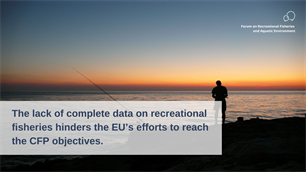
From January this year onwards, anglers fishing in EU coastal waters are obliged by EU legislation to register their catches in the “RecFishing” app. This is part of the European Common Fisheries Policy’s Control Regulation. It serves to gain a better understanding of the recreational fisheries sector’s overall fishing activity. EAA emphasises that, alongside assessing environmental impacts, greater attention must now also be given to collecting data on the socio-economic value of the activity.
Background – EU Fisheries control regulation reform, impact for recreational fisheries
The revised EU Fisheries Control Regulation (Regulation (EU) 2023/2842) was adopted in November 2023. It entered into force on 9 January 2024, following five years of legislative work between the Commission, the European Parliament and member states.
The revision aims to modernise and simplify fisheries monitoring, ensure compliance with the Common Fisheries Policy (CFP), and close longstanding data gaps — including some related to recreational fishing.
Under this new legal framework, recreational fishers who catch certain species in EU marine waters will need to report those catches electronically, helping to establish a comprehensive and accurate understanding of the recreational fishing landscape.
What changes for sea anglers
From 10 January 2026, recreational sea anglers are subject to the following obligations:
- Mandatory electronic reporting of catches of selected species;
- Same-day reporting,
- Use of either the EU RecFishing app or a national online reporting system, depending on the Member State.
Several coastal Member States will use the EU RecFishing app (see list below), developed by the European Commission, in close cooperation with national authorities, scientists and recreational fishing stakeholders.
- Belgium
- Cyprus
- Denmark
- France
- Germany
- Ireland
- Italy
- Malta
- The Netherlands
- Poland
- Portugal
- Romania; and
- Sweden
Recreational fishers in the listed countries can contact their national authorities or angling association for more information on the rollout and implementation of the online reporting system. Other coastal EU Member States developed their own national online reporting system (app).
A positive step forward, but key issues remain unsolved
The European Anglers Alliance (EAA) underlines the importance of mapping fish stocks and their sustainable management. Transparency throughout the fishing chain, of which recreational/sport fishing is a part, is important. Especially when it comes to fish stocks that are under pressure.
At the same time, several important questions remain. It is still unclear clear how the new registration obligation will be monitored and what consequences this may have. In any case, the introduction of additional obligations for marine recreational anglers that will lead to unilateral restrictions is not negotiable for the organized angling community.
In addition, EAA emphasises that socio-economic benefits — including angling’s contribution to coastal communities and public health — should be considered alongside environmental effects in future policy decisions.
EAA members have also identified several challenges linked to the national implementation of the provisions for recreational fisheries under the revised Fisheries Control Regulation, including:
- A lack of national legal basis and planning security
- Some EU Member States have not yet established the necessary national legal basis for implementation, despite the Regulation entering into force in 2026. This creates uncertainty for both anglers and enforcement authorities, on the local, national level.
- Risk of frustration rather than cooperation by the angling community
- As the RecFishing app (or national equivalents) offers few incentives for voluntary use, several EAA members expect frustration among anglers rather than constructive engagement.
- This concern is compounded by the limited usefulness of the catch data requested, while valuable information on the socio-economic dimension of marine recreational fishing is not being collected.
- Insufficient inclusion of all anglers
- The current system relies exclusively on digital reporting and does not provide an analogue alternative. This risks excluding anglers who lack adequate digital equipment or digital literacy.
Without a more pragmatic and angler-friendly approach, EAA members warn that the new reporting obligations risk undermining acceptance of EU fisheries policy among the recreational fishing community.At the same time, the EAA looks forward to continuing constructive cooperation with Member States and EU institutions to address the remaining challenges and ensure that the angling community’s perspective is fully considered in the further development and practical implementation of these measures.
Links & more information
For more information on the EAA and EFTTA’s position on the Fisheries Control revision, click here