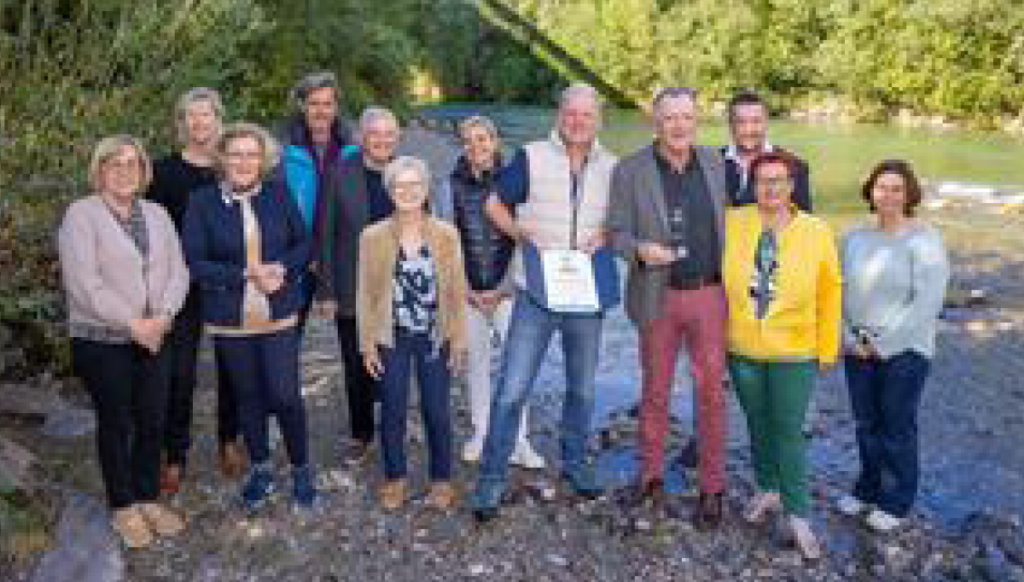

Participants at the 1st Asia International Eel Symposium on Amami, Japan (c) Hikaru Itakura (2025)
The focus on Amami Island was on (sub-)tropical eel species and the proposal by the European Union and Honduras to list all eel species in Appendix II of the Washington Convention on International Trade in Endangered Species (CITES).
The latter was also the reason why the DAFV participated in this symposium with a presentation entitled “Assessing the implications of a CITES Appendix II listing for all Anguilla eels”. On the one hand, the DAFV believes it is important to analyse and weigh up the potential consequences for species protection and utilisation in advance of new regulations on the eel trade under CITES. On the other hand, the successful implementation of such a change can only work in close cooperation and exchange with Asian countries. With Japan being the world’s largest consumer of eel products, this was exactly the right place and setting to hold this dialogue. Over the past few months, our colleague Florian Stein has been working intensively on this topic and has published a mini-essay with colleagues from the Netherlands, the United Kingdom and Hong Kong (Stein et al, 2025a). A second paper on the same topic is currently under review and is expected to be published shortly (Stein et al, in review).
Possible changes to the Washington Convention on International Trade in Endangered Species (CITES) and potential consequences
The two papers by Stein and his co-authors (2025a, b) deal with the international trade in eels of the genus Anguilla and the possible effects of a new CITES regulation. The proposal by the European Union and Honduras to include all Anguilla species in Appendix II (CITES, 2025a) is intended to make trade more transparent and sustainable. The European eel (Anguilla anguilla) is already listed in Appendix II, and an upgrade to Appendix I, as was still being discussed at the beginning of 2025, has not been requested.

Scientist Tatsuhiko Maeda from the University of Tokyo with a large Marmorata eel on Amami Island, Japan © Tatsuhiko Maeda
Since the young fish (glass eels) of the genus Anguilla and the processed fillets are very similar, they can only be distinguished by DNA testing, which makes control difficult. The global trade in glass eels is complex and involves both legal and illegal flows, particularly to Asian aquaculture. Some countries, such as Japan and China, reject the proposal to list all eels in Appendix II, citing the economic importance and good stock status of the Japanese eel. The Food and Agriculture Organisation of the United Nations (FAO) considers that the conditions for listing are not met and rejects the changes (FAO, 2025), while the CITES Secretariat considers that the criteria for listing all eel species are met (CITES, 2025b).
The listing of the European eel in 2010 led to unexpected consequences such as increased smuggling from Europe to Asia (see also Stein et al, 2024). The authors call for a careful assessment of the potential consequences and stronger international cooperation to improve the protection of all Anguilla species (Stein et al, 2025a, b).
As expected, the representatives of state research institutions from China and Japan who were present were very sceptical about the proposal. In their view, the Japanese eel (Anguilla japonica) is currently well protected by regional management agreements. However, the overwhelming economic importance of eel aquaculture for some Asian countries was also openly discussed. According to a colleague from the East China Fisheries Research Institute, Chinese eel aquaculture alone employs around 300,000 people. However, colleagues from academic institutions in Japan and Taiwan assess the situation quite differently. According to their stock estimates, the Japanese eel population continues to decline at an alarming rate (Kaifu et al, 2025).
A decision on the proposal to list all Anguilla eels in Appendix II of the Washington Convention on International Trade in Endangered Species will be made during the upcoming CITES conference between 24 November and 5 December 2025 in Sarmarqand, Uzbekistan.
Anguilla marmorata – the king of the tropics
The marbled eel (Anguilla marmorata) is the most widespread of the subtropical-tropical species. Its range extends from East Africa in the west to the Fiji Islands in the east and from Indonesia in the south of Southeast Asia to the Japanese Ōsumi Islands in the north. Due to its distribution and impressive appearance, it was aptly described by a symposium participant as the “king of tropical eels”. However, usually it is the females that grow bigger – the QUEEN of the tropics!
The majority of the 19 eel species and subspecies live in tropical and subtropical regions of the world. However, research in the past has focused predominantly on the three temperate species in the northern hemisphere: the Japanese eel (Anguilla japonica), the American eel (Anguilla rostrata) and the European eel (Anguilla anguilla). Of the tropical species, Anguilla marmorata was clearly the focus of attention on Amami. If you take a closer look at the eel, you will quickly see where its name comes from. Most of its body surface is beautifully marbled (see photos).

Well camouflaged. An Anguilla marmorata with the eponymous pattern on its back, Amami Island, Japan. © Joshua Choo (2025)
The lecture programme of the symposium was divided into five sections:
- Ecology: River phase
- Ecology: Marine phase
- Biogeographical distribution and evolution
- Conservation and applied ecology
- Trade, management and conservation policy
The 30 presentations were extremely diverse and exciting, but of course each session had its highlights. Yuha Hasegawa from Nagasaki University used X-ray video recordings to demonstrate in detail how glass eels that have already been swallowed can escape their predators by swimming tail-first out of the fish’s stomach and then through its gills. Tasuhiko Maeda from the University of Tokyo presented a non-lethal method for analysing the stomach contents of Marmorata eels.
And Mukhlis Kamal from the Agricultural University in Bogor, Indonesia, reported on the protective measures in Indonesia in his keynote speech. A murmur went through the audience when he showed video footage of rivers on the south coast of Java, where glass eel populations are still so large that they can be scooped out of the river with bare hands for sampling.
In the artificial reproduction of Japanese eels, the Japanese Fisheries Research Agency has now progressed to the point where crossbreeding experiments with Marmorata eels are also being carried out. The fifth session focused primarily on trade, management and conservation policy.
Five of the seven presentations discussed current problems with the traceability of eel products and the partly illegal global trade in glass eels in connection with the application for amendment of the CITES listing. The lecture programme was supplemented by excursions. During the electrofishing excursion in one of the numerous short rivers on the mountainous island, several specimens of Anguilla marmorata were caught.

Symposium participants during electrofishing, Amami Island, Japan. © Hikaru Itakura (2025)

Two participants from New Zealand and Japan with a marbled eel, Amami Island, Japan. @Hikaru Itakura (2025)
We would like to express our sincere thanks to the European Anglers Alliance (EAA) for co-financing our participation in the symposium in Japan.
Literature
- CITES (2025a). Proposal to include Anguilla japonica and Anguilla rostrata in CITES Appendix II, in accordance with Article II, Paragraph 2 (a) of the Convention and Criterion B of Annex 2a, and to include all non-CITES species of the genus Anguilla in CITES Appendix II in accordance with Article II, Paragraph 2 (b) of the Convention and satisfying Criterion A of Annex 2b of Resolution Conf. 9.24 (Rev. CoP17) for reasons of similarity to A. anguilla, or to one of the proposed species (Anguilla japonica and Anguilla rostrata) in live/processed form. CoP20 Pro. 35. Retrieved from https://cites.org/sites/default/files/documents/COP/20/prop/E-CoP20-Prop-35.pdf
- CITES (2025b). Notification to the Parties No. 2025/102. Convention on International Trade in Endangered Species of Wild Fauna and Flora. Retrieved from https://cites.org/sites/default/files/notifications/E-Notif-2025-102.pdf
- FAO (2025). Report of the Eighth FAO Expert Advisory Panel for the Assessment of Proposals to Amend Appendices I and II of CITES Concerning Commercially-Exploited Aquatic Species – Bangkok, 7–11 July 2025 and Rome, 21–25 July 2025. FAO Fisheries and Aquaculture Report, No. 1482. Rome. Retrieved from https://doi.org/10.4060/cd6542en
- Kaifu K, Itakura H, Kotani T, Shinoda A, Han YS, Yoshinaga T & Wakiya R (2025). A decade after being listed as Endangered: Japanese eel stock inferred from fishery-dependent and independent monitoring records. Regional Studies in Marine Science, 104456.
- Stein FM, Nijman V, Lau MCW, Dekker W (2025a). Eels: Uncertain impacts of proposed CITES listings. Oryx, 59(1): 12-13. doi: 10.1017/S0030605325000018
- Stein FM, Nijman V, Lau MCW & Dekker W (under review). Inclusion of all Anguilla eel species in CITES Appendix II will support their sustainable management across the globe.
- Stein FM, Troneci A, Jesus J, Alfaro Moreno JA (2024). Europe’s biggest wildlife crime: Eight years of coordinated actions against eel trafficking. Trends in Organised Crime, 27: 496-502.doi: 10.1007/s12117-024-09540-6