
dfdfdf
dfdfdfdfdfdfd
- saasasaas
- asasasa
- asasasa
fdfdfdf dfdfsff sdsfdsdd sdsddsd
Socio-economic data
Studies on angling in Europe are scarce, both at the European and national levels. They usually focus only on sea angling, while freshwater angling can be significant share in some countries. Furthermore, it is difficult to compare them with each other, given that terms, definitions and methodology often differ. That is why the EAA is calling on the European Commission to deliver a pan-European study on recreational angling (both at sea and in freshwaters) every five years, as it is already the case in the US and in Canada.
Introduction – TOPICS
Copyright: Johannes Arlt
The European Anglers Alliance’s mission is to advocate for the rights and interests of recreational anglers while promoting responsible and sustainable fishing practices. As an organization deeply committed to preserving European waters and ensuring the future of recreational fishing for generations to come, we focus on a diverse range of essential topics.
In this section you can read about key topics on which we focus our activities.
What is recreational fishing?
Recreational fishing is fishing, which is not deemed to be commercial fishing.
Recreational angling is one form of recreational fishing. According to the paper published by the EAA in 2004 (also available in French), angling can be defined as line fishing using the hooking method. As angling can be both commercial and non-commercial, recreational angling can be defined as the activity of catching or attempting to catch fish, principally by rod and line, pole or hand-held line for non-commercial purposes. According to the EAA definition and EU legislation (Article 55(2); Council Regulation (EC) No 1224/2009 of 20 November 2009), recreational fishermen and recreational anglers do not sell the fish they catch.
The term “recreational angling sector” means anglers, tackle shops and tackle manufacturers, bait suppliers, charter-boating, recreational boat builders and handlery suppliers, marina operators and specialised angling media, angling tourism and other related business and organisations as well as the whole management environment (e.g. public agencies) to varying degrees dependant on or directed at recreational angling.
Recreational angling is a very sustainable kind of fishing compared to other kinds of fishing, commercial as well as recreational, thanks to the low-impact, highly selective catching gear used and the high survival rate of the fish released-. In many countries recreational fishing generates more value than does commercial fishing. Within the recreational fishing sector the recreational angling segment contributes by far the most to the sector’s total socio-economic value.
EIFAC Code of practice for recreational fisheries
In 2008 EIFAC, the European Inland Fisheries Advisory Commission adopted and published the “EIFAC Code of practice for recreational fisheries“.
The publication is written in English but has a ‘non-official translation’ annexed – from page 23 onwards: “Code d’usages de la CECPI pour les pêches de loisir”.
Some cuttings from the EIFAC Code:
INTRODUCTION
Recreational fishing constitutes the dominant or sole use of many freshwater stocks in the EIFAC region. Its importance is also increasing in economies in transition of that region. Yet little attention has been paid in international policy documents to the responsible management of recreational fisheries. This creates confusion among policy-makers, national and regional bodies, and organizations responsible for fisheries management. As a consequence, the issues faced by this sector are often overlooked or undervalued by policy-makers and in public discussion about the future of the world’s fisheries. The present document aims at addressing this imbalance.
The EIFAC Code of Practice [CoP] for Recreational Fisheries is intended to complement and extend the FAO Code of Conduct for Responsible Fisheries, and is framed specifically towards recreational fisheries practices and issues. It serves as the core document that describes the minimum standards of environmentally-friendly, ethically-appropriate and – depending on local situations – socially acceptable recreational fishing and its management. Although it is clear that many, if not all, of the issues presented in this CoP are already addressed through national fisheries legislation and regional fisheries management regulations in many countries in the EIFAC region, an EIFAC CoP could help make these approaches more coherent. The present CoP is a voluntary instrument adopted and disseminated by the European Inland Fisheries Advisory Commission (EIFAC).
Cuttings from the GLOSSARY (page 20 onwards)
Commercial fisheries:
fisheries whose primary aim is to generate resources to meet nutritional (i.e. essential) human needs; in both full-time and part-time commercial fisheries, fish and other aquatic organisms are sold on domestic and export markets. Commercial fisheries include fisheries that supply feed to the aquaculture and agriculture sectors and raw material to other industrial sectors (e.g. the biomedical sector).
Recreational fishing:
fishing of aquatic animals that do not constitute the individual’s primary resource to meet nutritional needs and are not generally sold or otherwise traded on export, domestic or black markets. The unambiguous demarcation between pure recreational fisheries and pure subsistence fisheries is often difficult. However, using fishing activity to generate resources for livelihood marks a clear tipping point between recreational fisheries and subsistence fisheries. Globally, angling is by far the most common recreational fishing technique, which is why recreational fishing is often used synonymously with (recreational) angling.
Recreational fisheries sector:
the entire network of stakeholders involved in or fully or partly dependent on recreational fisheries including amongst others fisheries ministries and agencies, managers, non-governmental organizations (e.g., umbrella angling associations and clubs), anglers, non-angling recreational fishers, tackle shops and tackle manufacturers, bait suppliers, charter-boating industry, recreational boat builders and chandlery suppliers, marina operators and specialised angling and fishing media, recreational fishing tourism and other related business and organisations as well as all other enterprises supporting recreational fisheries including aquaculture operations that produce stocking material or commercial fishing enterprises that sell angling tickets on their waters. A range of other stakeholders and managerial regimes are not included in this definition though they may run or advocate activities and developments that have a direct impact on the recreational fishing quality and the recreational fisheries sector, the sector’s viability and growth potential (e.g., hydropower generation, water management, irrigation).
Subsistence fisheries:
fishing for aquatic animals that contribute substantially to meeting an individual’s nutritional needs. In pure subsistence fisheries, fishing products are not traded on formal domestic or export markets but are consumed personally or within a close network of family and friends. Pure subsistence fisheries sustain a basic level of livelihood and constitute a culturally significant food-producing and distributing activity.
Recreational fishing in EU legislation
Recreational fisheries have been defined in some pieces of EU legislations, although not in the Common Fisheries Policy. For example, the Regulation (EU) 2017/1004 on data collection gives the following definition: “’recreational fisheries’ means non-commercial fishing activities exploiting marine biological resources for recreation, tourism or sport.”
Recreational fishing and angling are also mentioned in other pieces of EU legislation. Some examples:
- Council Decision of 19 July 2004 establishing Regional Advisory Councils under the Common Fisheries Policy– Article 1(3): ‘Other interest groups’ shall mean, amongst others, environmental organisations and groups, aquaculture producers, consumers and recreational or sport fishermen.
- The Control Regulation(2009) – Chapter V – Control of recreational fisheries – Article 55 – Recreational fisheries
- The Common Fisheries Policy(2013) recognises that “recreational fisheries can have a significant impact on fish resources and Members States should, therefore, ensure that they are conducted in a manner that is compatible with the objectives of the CFP.”
- Regulation (EU) No 508/2014 on the European Maritime and Fisheries Fund supports the collection, management and use of data, including for at-sea monitoring of recreational fisheries.
In recent years, and for the first time, the Commission took into account the socio-economic aspects of recreational fisheries:
- in the management plan for fish stocks in the Atlantic and North Sea (Regulation (EU) 2018/973 of 4 July 2018), including for seabass; and
- in the management plan for fish stocks in the Western Mediterranean Sea (Regulation (EU) 2019/1022 of 20 June 2019)
Furthermore, while there is no explicit mention of recreational fishing in ‘Commission delegated regulation (EU) 2015/242 of 9 October 2014 laying down detailed rules on the functioning of the Advisory Councils under the Common Fisheries Policy’ (2014). However, recreational fishing (recreational angling/sportfishing) is still accepted and represented in the ‘Other interest groups’ as it has been the case since 2004. The European Anglers Alliance participates in 5 Advisory Councils (Mediterranean Sea, North Sea, Baltic Sea, Aquaculture, North-western waters).
Data collection
-
Commission Regulation (EC) No 1639/2001:
Chapter III – Parameters – “data collection must make it possible to assess: catches from recreational and game fisheries in marine waters for stocks mentioned in Appendix XI,”
Complementary parameters – “catches from game and recreational fisheries for stocks other than those mentioned in Appendix XI, for salmon, the catches taken in estuaries, lakes and rivers in the geographical area of the Baltic Sea and the North Sea.”●Regulation (EU) 2017/1004 on the establishment of a Union framework for the collection, management and use of data in the fisheries sector and support for scientific advice regarding the common fisheries policy: it recognises that “it is important to “collect biological data on recreational fisheries where there is a potentially significant impact on the state of the stock, in order to enable ecosystem-based management and conservation as necessary for the operation of the common fisheries policy, as well as to improve stock assessment.”
Mediterranean Sea
-
Council Regulation (EC) No 1967/2006concerning management measures for the sustainable exploitation of fishery resources in the Mediterranean Sea
Article 2(8): ‘leisure fisheries’ means fishing activities exploiting living aquatic resources for recreation or sport;
Article 17 – Leisure fisheries: Rod and line (angling) is permitted but (Art 17(1)):
“The use of towed nets, surrounding nets, purse seines, boat dredges, mechanised dredges, gillnets, trammel nets and combined bottom-set nets shall be prohibited for leisure fisheries.
The use of longlines for highly migratory species shall also be prohibited for leisure fisheries.”
The Common Fisheries Policy (CFP)
The Common Fisheries Policy (CFP) sets rules for managing European fishing fleets and for conserving fish stocks. It aims to ensure that fishing and aquaculture are environmentally, economically and socially sustainable and that they provide a source of healthy food for EU citizens.
The CFP was first introduced in the 1970s and went through successive updates, the most recent of which took effect on 1 January 2014.
The CFP regulation, which is the overarching EU legislation on fisheries, refers only once to recreational fisheries: “Recreational fisheries can have a significant impact on fish resources and Member States should, therefore, ensure that they are conducted in a manner that is compatible with the objectives of the CFP.”
However, in its answer to a parliamentary question tabled by MEP Richard Corbett (UK, S&D) in November 2015, the Commission acknowledges that the key Article 17 of the CFP regulation – which concerns the criteria for the allocation of fishing opportunities by Member States – does not exclude the extension of its scope to include recreational fishing.
Other EU fisheries legislations adopted in the recent years tend to progressively include recreational fisheries.
Read more about recreational fisheries and the EU legislation here.
EAA position: Marine recreational fisheries must be included in the CFP
The European Anglers Alliance has organised several events and published a position paper to support its call for recreational fisheries to be fully recognised in the CFP as a distinct sector.
The recreational sector and its value chain already represent a large proportion of the employment along rural and coastal regions of Europe. It is time to take the brakes off the MRF sector and to serve coastal economies with sustainable, well-paid jobs. It is time to offer a level playing field to the millions of Europeans who want to enjoy the public resource that are our fish. It is time to really acknowledge marine recreational fisheries as a part of the fisheries sector and to fully consider it as an integral part of coastal fisheries management and the Common Fisheries Policy.
Related news items
It is high time to include Marine Recreational Fisheries in the Common Fisheries Policy (June 2022)
RecFishing Forum event: Exploring the inclusion of marine recreational fisheries in the Common Fisheries Policy (March 2022)
Whose fish is it anyway? Whose interests? Reply of the European Commission on what a non-discriminatory approach to recreational fisheries means (September 2020)
RecFishing Forum event: EU recreational fisheries sector advocates for full recognition in the Common Fisheries Policy (February 2020)
MEP Annie Schreijer-Pierik confirms her support for the full inclusion of recreational fisheries in the CFP (November 2019)
The European Parliament asks for fair management of recreational fisheries (May 2018)
EU anglers and industry made the case that a full and fair recognition of the RecFish Sector in the CFP is overdue (January 2018)
EAA President asks full recognition for recreational fisheries in the CFP in the European Parliament (March 2017)
TOPICS
- EU Biodiversity Strategy
- Water Framework Directive
- Hydropower
- Cormorants
- Fisheries Control
- Sea bass
- Socio-economics
- Angling tourism
Socio-economic data
Studies on angling in Europe are scarce, both at the European and national levels. They usually focus only on sea angling, while freshwater angling can be significant share in some countries. Furthermore, it is difficult to compare them with each other, given that terms, definitions and methodology often differ. That is why the EAA is calling on the European Commission to deliver a pan-European study on recreational angling (both at sea and in freshwaters) every five years, as it is already the case in the US and in Canada.
EAA’s proposal for a pan-European anglers survey
Definitions
One definition that seems to be agreeable by all parties is the one of the International Council for the Exploration of the Sea (ICES) for marine recreational fisheries: “the capture or attempted capture of living aquatic resources mainly for leisure and/or personal consumption. This covers active fishing methods including line, spear, and hand-gathering and passive fishing methods including nets, traps, pots, and set-lines” (2013).
A study by the Centre for Environment, Fisheries and Aquaculture Science (Cefas) distinguishes between different terms related to recreational fishing:
| Recreational fishing | Recreational fishing is fishing which is:
• not deemed to be commercial fishing; • is not undertaken for predominantly subsistence purposes; • is not undertaken for primarily cultural or heritage purposes |
| Angling | Angling is the activity of catching or attempting to catch fish on hooks, principally by rod and line, pole or hand-held line. Note that this also includes the use of hook-less lures where fish capture depends on entanglement (e.g. billfish, squid, eels) |
| Recreational angling | Recreational angling is the activity of catching or attempting to catch fish, principally by rod and line, pole or hand-held line for non-commercial purposes; recreational anglers do not sell the fish they catch. |
| Sports fishing | Sports fishing is generally perceived to be a sub-set of recreational angling, although the distinction varies between countries. |
| Non-angling recreational fishing | Other forms of non-commercial recreational fishing (i.e. not with hook and line) include:
• small boats equipped with nets or longlines; • use of fish or crustacean pots; • capture of fish by divers with spear guns; • hand-gathering of shellfish from the beach or shore |
Reproduced from M. G. Pawson, D. Tingley, G. Padda and H. Glenn, EU contract FISH/2004/011 on “Sport Fisheries” (or Marine Recreational Fisheries) in the EU, March 2007
European Parliament study
In 2017, the European Parliament Fisheries Committee (PECH) commissioned a study on “Marine recreational and semi-subsistence fishing – its value and its impact on fish stocks.” The study only focuses on marine recreational fishing, and fails to take into account the value and impacts on freshwater recreational fishing.
It concluded that the “total economic impact of marine recreational fishing amounts to 10.5 billion euro, supporting almost 100,000 jobs. The impact varies between fish stocks, representing 2-72% of total catch.”
Estimation of direct, indirect and induced effects, for production and employment for European countries with marine recreational fisheries (selection)
| Country | Total production
(million euro) |
Total employment
(FTEs) |
| Belgium | 60 | 407 |
| Bulgaria | 61 | 593 |
| Croatia | 39 | 383 |
| Cyprus | 9 | 161 |
| Denmark | 249 | 1,877 |
| Estonia | 10 | 213 |
| Finland | 180 | 1,311 |
| France | 2,324 | 24,527 |
| Germany | 176 | 1,957 |
| Greece | 106 | 1,116 |
| Ireland | 195 | 2,029 |
| Italy | 460 | 4,562 |
| Latvia | 16 | 358 |
| Lithuania | 26 | 586 |
| Malta | 6 | 62 |
| Netherlands | 270 | 1,835 |
| Poland | 39 | 433 |
| Portugal | 240 | 2,513 |
| Romania | 168 | 1,679 |
| Slovenia | 36 | 374 |
| Spain | 374 | 3,921 |
| Sweden | 1,010 | 8,921 |
| UK | 2,370 | 24,632 |
| Total EU | 8,422 | 84,452 |
Reproduced from Hyder, K, Radford, Z, Prellezo, R, Weltersbach, MS, Lewin, WC, Zarauz, L, Ferter, K, Ruiz, J, Townhill, B, Mugerza, E, & Strehlow, HV, 2017, Research for PECH Committee – Marine recreational and semi-subsistence fishing – its value and its impact on fish stocks, European Parliament, Policy Department for Structural and Cohesion Policies, Brussels
European Parliament Committee on Fisheries’ hearing on “Data collection and recreational fisheries”
On 30 November 2021, the Committee on Fisheries of the European Parliament held a public hearing on “Data collection and recreational fisheries”. This meeting was the opportunity to highlight a severe lack of data on recreational fisheries, a sector that has been increasingly managed at European level over the past years.
Invited to speak at this hearing, EAA and EFTTA made a strong call for a pan-European survey to be undertaken every 5 years to evaluate the economic and social value of the recreational fisheries sector.
Better data on the environmental, economic and social impacts of recreational fisheries is essential to improve the management of these fisheries and to achieve the Common Fisheries Policy (CFP) objectives. EAA and EFTTA also urged the Members of the European Parliament to work for the inclusion of recreational fisheries in the CFP as an integral sector.
You can find a more detailed summary of the meeting here.
Socio-economic data – Austria
In 2025, there were around 690.000 Austrian citizens that have an affinity for fishing (having executed recreational fisheries activities in last 12 months), while the country has over 350.000 active anglers (=4% of the population).
The proportion of women engaged in recreational fisheries activities has doubled since 2000, acounting now up to 6% of all Austrian anglers.
On average, the Austrian angler fishes 16 days per year. The average age to start angling in Austria is at 16.5Years.
It is estimated that recreational fishers have an annual direct and indirect contribution to the economy of €600-800 million.
The estimated, average expenses per recreational fisherman/woman per year accounts up to €2.180.
Angling tourism is important in Austria, but there is no reliable data at the moment.
Reference:
Österreichischen Kuratoriums für Fischerei und Gewässerschutz, Soziale und ökonomische Bedeutung der Angelfischerei in Österreich, June-September 2000.
Socio-Economic Studies – Belgium
Flemish Region:
More information on Recreational fisheries in the Flemish region: https://www.recreatievezeevisserij.be/publicaties/
Cormorants
In Europe, the cormorants’ population has grown significantly in recent years putting a great pressure on and provoking damages to angling, fisheries and aquaculture activities alike.
Cormorants are highly adaptable predatory birds which require to eat around 400-600 grams of fish per day for their sustainment. In 2014, it has been estimated that there were more than 2.2 million cormorants in Europe and this figure is constantly growing. These two data well-represent the reason why cormorants have become an issue in Europe: the impact that these birds have on fish stocks is huge and they represent a threat to the survival of several aquatic species such as eel, grayling and salmon.
In order to ensure a good balance between the interests of anglers and the conservation of birds, fish and biodiversity, the EAA supports the development of a pan-European management plan for the cormorants and demands an improved system for the collection of scientific data.
Legal background
As wild birds, cormorants are protected by the Birds Directive. The conservation measures included in the Directive, added to the fact that cormorants don’t have any natural predator, have contributed to the rapid expansion of the population. The Directive allows Member States to derogate to the conservation measures if “serious damage” is provoked by the birds, but this criteria needed clarification.
In 2008, the European Parliament adopted a resolution urging the adoption of a Europan cormorant management plan. The resolution acknowledged that a common European approach in this matter is needed as local measures have proved to be ineffective in mitigating the impact of cormorants on fish stocks.
Despite the European Parliament’s action, the European Commission decided to not proceed with the formulation of a proposal for a management plan but presented instead a Guidance Document to clarify the interpretation and the legal application of derogations foreseen by the Bird Directive to the cormorant case.
The EAA fully supports the appropriate implementation of the Birds Directive, which is an important piece of the EU environmental legislation. Similarly, the EAA promotes the establishment of a European management plan for cormorants to ensure the good conservation of birds and fish stocks.
More information
EAA position paper – Cormorants (2020)
EAA position paper – Cormorants, problems and solutions (2015)
How many Cormorants in Europe? – A Documentation of EAA, Author: Franz Kohl (ÖKF); Sept. 2015
Fisheries control
The objectives of the Common Fishery Policy (CFP) are to ensure that fishing is environmentally sustainable in the long-term and are managed in a way that is consistent to achieving economic, social and employment benefits. One of the ways to do this is to avoid and prevent overfishing.
Full and proper implementation is key to ensure the success of the objectives foreseen by the European Union. As such, the European Commission proposed the Fisheries Control Regulation, which entered in effect in 2009 to ensure compliance with the rules of the CFP, through an effective control and enforcement system. Such a system is also key to achieve fully documented fisheries.
Legal background
The Council Regulation (EC) No 1224/2009 establishing a Community control system for ensuring compliance with the rules of the common fisheries policy defined recreational fisheries as “non-commercial fishing activities exploiting marine living aquatic resources for recreation, tourism or sport” (art. 4.28).
It recognises notably that recreational fisheries can have a significant impact on fish resources. As such, it calls on Member States to collect catch data for stocks under a recovery plan. It even includes the possibility for the Council to decide on specific management measures for recreational fisheries, upon advice of the Scientific, Technical and Economic Committee for Fisheries (art. 55).
Revision of the Control Regulation (2018 – ongoing)
After conducting an evaluation of the control system in 2017 (results of the public consultation are available here, and report to the European Parliament and the Council here), the Commission concluded that the Control Regulation is essential to guarantee proper enforcement of the CFP and to achieve its objectives, but that some provisions were too complex and not fit for purpose. It also found that some provisions were already obsolete and that some lacked flexibility.
The Commission noted a lack of control provisions relating to recreational fisheries, considered necessary by citizens and stakeholders.
As such, the Commission proposed in 2018 a revision of the control system, proposing a number of changes to step up enforcement. On recreational fisheries specifically, it proposed, amongst others:
- A registration or licensing system to allow for the monitoring of the number of persons involved in recreational fisheries;
- The collection of reliable data on catches;
- The marking of fishing gears; and
- The registration of recreational vessels.
The revision also clarifies the wording about the ban on sales of catches by recreational fishers.
For more information on EAA and EFTTA position on the recreational fisheries provisions, read more here.
Related news items
Including marine recreational fisheries in the CFP: can the EU afford not to? (March 2021)
Fisheries control revision: last chance for the European Parliament to make it right (March 2021)
EU pilot project on recreational fisheries control finally underway (March 2020)
The revision of the fisheries control system ongoing in Brussels (February 2020)
Fisheries Control: the Commission’s proposal for a revised regulation published (June 2018)
EU fisheries control: “More efforts needed”, says Court of Auditors (June 2017)
TOPICS
- What is Recreational Fishing?
- EU Biodiversity Strategy
- Water Framework Directive
- Hydropower
- Cormorants
- Fisheries Control
Socio-economic data – Denmark
According to available data, there are up to 616,000 people that go fishing at least one day per year, which represents around 10.3% of the population.
It is estimated that recreational fishers have an annual direct and indirect contribution to the economy of between €146 and €386 million(DKR 1.1 and DKR 2.9 billion). They also support around 2,500 jobs in the country.
In terms of angling tourism, it is estimated that the country hosts around 130,000 angling tourists each year, generating a direct and indirect economic impact estimated to be between €22 and €56 million (DKR 165 and DKR 420 million).
References:
Carl Henrik Marcussen (Center for Regional- og Turismeforskning), Status for lystfiskerturismen i Danmark – Input til strategi for lystfiskeri og udvikling af lystfiskerturismen, April 2017
COWI, Analyse af adfærd, motive og præferencer blandt danske lystfiskere, March 2010
Ministeriet for Fødevarer, Landbrug og Fiskeri, Lystfiskeri i Danmark– Hvem? Hvor meget? Hvordan?, March 2010
On salmon: DTU Aqua Institut for Akvatiske Ressourcer, Den lokaløkonomiske værdi af laksefiskeriet i Skjern Å, 2014
Socio-economic data – Finland
According to available data, in 2018, there are around 1,5 million anglers. This means that one in four (27%) Finns is engaged in recreational fishing. In comparison to year 2016, there is an increase in the volumes of children and young people engaging in recreational fishing.
The Finnish recreational fishers spent €249 million on their hobby in 2017. This sum only includes the fishermen between 18-64 years, who bought the fisheries management fee. Therefore, the €249 million figure is a minimum estimation.
New research results on the recreational value of recreational fishing will be published later this year by the Natural Resources Institute Finland. In this research, the economic impact of travel has been better taken into account.
There are no exact data concerning the amount of angling tourists per year, only an estimation based on the tourists using local fishing guides.
References:
Jani Pellikka & Päivi Eskelinen, Vapaa-ajankalastajien profiilit, 2019
Luke (Natural Resources Institute Finland): Statistics database on recreational fishing
Luke (Natural Resources Institute Finland): Recreational fishing 2018
Pohja-Mykrä Mari, Matilainen Anne, Kujala Susanna, Hakala Outi, Harvio Viktor, Törmä Hannu, Kurki Sami, Erätalouteen liittyvän yritystoiminnan nykytila ja kehittämisedellytyksetv, May 2018
Socio-Economic Studies – France
Recreational sea fishing – study 2011-2013
More background information available here
‐ Number of recreational sea fishers (ex. beach walkers / “pêche à pied”): 1,319,000
– Trips per year: ca. 9 mill.
– Expenditure total (gear, lures, baits, boats): ca. 530 mill. €
(equals ca. 402 € per fisher; or 59 € per trip)
—————-
————————-
La pêche récréative et sportive: quel poids économique?
Les pêcheurs de loisirs ont été sondés par BVA, à leur demande, l’ objectif étant de disposer de données objectives et incontestables sur leur activité. Les premiers résultats de cette étude font apparaître qu’un peu plus de 3 millions de personnes, de toutes tranches d’âge sont concernées. Le prélèvement par rapport aux pêcheurs professionnels serait compris entre 2 et 4 %. Enfin, l’impact économique direct de ce loisir serait de 5 à 8 milliards d’euros. cf Marin N° 3053, 13/01/06 (no link) Le président de la Confédération Nàtionâle de la Plaisance et de la Pêche en Mer (CNPPM) évoque pour nous les résultat de I’enquête BVA (Côt & Pêche No 1, May-June 2007)
Socio-economic data – Germany
According to available data, in 2017, there are 1.73 million anglers, registered with a state fishing license. Furthermore, a 2002 study estimates that around 3.3 million people (>14 years old) have fished at least once in Germany or abroad. In terms of sea fishing, research from the European Parliament estimates that there are around 174,000 recreational sea fishers in 2013.
It is estimated that recreational fishers have an annual direct and indirect contribution to the economy of over €6.4 billion. They also support around 52,000 jobs in the country.
There are no reliable figures on fishing tourism in Germany. Foreign tourists are rarely found except in the coastal regions. The reason for this is the required fishing license, which requires the attendance of a preparatory course and passing an examination. Some federal states, like Mecklenburg-Western Pomerania or Schleswig-Holstein, sell a tourist fishing license which does not demand these requirements.
References:
Clemens Strehl, Studie zur ökonomischen und gesellschaftlichen Bedeutung der Angelfischerei in Nordrhein-Westfalen, 2013
Dr. Uwe Brämick (Institut für Binnenfischerei e.V. Potsdam-Sacrow), Jahresbericht zur Deutschen Binnenfischerei und Binnenaquakultur, 2017
European Parliament Directorate-General for Internal Policies, Research for PECH Committee – Marine recreational and semi-subsistence fishing – its value and its impact on fish stocks, 2017
Robert Arlinghaus (IGB), Angelfischerei in Deutschland – eine soziale und ökonomische Analyse, 2004
Socio-economic data – Netherlands
According to available data from Wageningen Marine Research, in 2017, there are in total 1.12 million anglers in the Netherlands, divided between 1 million anglers in fresh waters and more than 500,000 anglers at sea. It represents around 6.4% of the population.
It is estimated, in 2017, that marine recreational fishers have an annual direct, indirect and induced contribution to the economy of over€270 million. They also support around 1,835 jobs in the country. A previous study, from 2010, estimates the direct effects of recreational fisheries for fresh and salted water represents over €341 million.
The number of foreign angling tourists has shown a strong increase of 62.9% between 2016 (41,620) to 2019 (67,779). Over 80 % of those tourists come from Germany. These data however strongly underestimate the reality. Beach holidays are very popular and sea angling does not require a license and therefore escapes registration. It is estimated that there are well over 100,000 foreign tourists each year.
Sportvisserij Nederland has commissioned a study into participation and effort trending. WMR will execute this work and the results of the study will be available in the second half of 2020. Based upon such insights, direct expenditure and economic impact of the angling sector in the Netherlands in more recent years can be deduced.
References:
European Parliament Directorate-General for Internal Policies, Research for PECH Committee – Marine recreational and semi-subsistence fishing – its value and its impact on fish stocks, 2017
Wageningen Marine Research: https://www.wur.nl/en/Research-Results/Research-Institutes/marine-research.htm
Recreational Seabass fishing in The Netherlands (2022)
Socio-economic data – Norway
According to the latest available data, 42% of the Norwegian population (age 16-74 years) is angling, both at sea (ca. 35%) and inland (ca. 30%).
It is estimated that the direct impact of inland fishing is over €44 million, and over €60 million when taking into account the ripple effects. There is no data for sea angling.
In terms of angling tourism, no data is available, but at least 300,000 German tourists visit Norway each year to go fishing.
Reference:
Andersen, O & Dervo, B.K., Jegernes og fiskernes forbruk av varer og tjenester i Norge i 2018, NINA Rapport 1605, Norsk institutt for naturforskning, 2019
Socio-economic data – Slovenia
According to the latest available data, there are around 12,000 angling club members in Slovenia, in 64 clubs across the country. In addition, there are around 8,000 day-tickets, which are sold to non-club members. Concerning sea angling, there are around 1,000 angling club members, as well as 1,000 licenses sold to tourist anglers.
Through the payment of angling concessions by the clubs, it is estimated that freshwater anglers contribute around €300,000 directly to the State budget. There is however no broader data on the economic impact of recreational fisheries.
Reference:
Caroline Sullivan, Barbara Jesensek, Dusan Jesensek, and Anka Zuza, An assessment of the importance of recreational sports fishing in the Upper Soca basin, Slovenia.
Socio-economic data – Spain
Numbers of anglers in Spain (2016)
Marine Recreational Fishers: 922,000
Inland Recreational Fishers: 615,000
Total Recreational Fishers: 1.58 Mill.
Read more :
Recreational fisheries in Catalonia, Spain (2019)
In 2019, it is estimated that there are 50,000 anglers in Catalonia, divided as follows: 60% are engaged in coastal fishing, 34% in boat fishing and 6% in spearfishing.
The total of recreational catches is estimated at 5% of total catches. Nevertheless, the recreational fisheries sector generates almost as much economic value as the commercial sector does: 90 million euros per year, which equals 86.8% of the commercial sector’s value.
With regard to the economic impact of the activity on the blue economy of Catalonia as a whole, the results indicate a total indirect impact of around 90 million euros per year linked to recreational sea fishing; of which a third corresponds to the direct impact on shops and distributors of materials to carry out the activity.
Reference:
ICATMAR, Direcció General de Pesca i Afers Marítims, Generalitat de Catalunya, Diagnosi de la pesca maritima recreativa a Catalunya (2019), 2020
English version: Diagnosis of Marine Recreational Fishing in Catalonia 2019 (ICATMAR)
Inland recreational fishing in Spain (2019)
A study for the Spanish Ministry for the Ecological Transition and the Demographic Challenge found that the average river fisher goes fishing 7 days/month, spending €57.81/day. In addition, the average river fisher allocated €575.85/year.
Given that in 2017, 532,805 fishing licenses were sold, it is estimated that the sector generates on average around €3 billion per year.
Building on this assessment, the study develops a set of recommendations regarding inland recreational fisheries. It recommends notably to incorporate the principles of conservation and sustainable use of biological diversity in the development of the tourism-fishing sector to give it added value. It is necessary to promote river fishing as a leisure element compatible with conservation and respect for the aquatic environment promoting the creation, maintenance and improvement of the training carried out in the
Regional Fishing Schools.
Reference:
OESA – Fundación Biodiversidad, La Pesca Recreativa Continental en España. Marco Jurídico y Caracterización, 2019
Socio-economic data – Sweden
In 2018, there were around 1.3 million anglers that went fishing at least once during the year, more than 12% of the population. They spend 10.9 million days fishing: 7.7 million days in lakes and rivers and 3.3 million days at sea.
Total expenditures in recreational fishing are estimated at €965 million divided as follows: around €292 million are spent in short-term costs, such as fishing equipment, travelling, fishing guides, food and accommodation; and €672 million in long-term investments, such as boats and more costly fishing equipment.
References:
Havs och Vatten myndigheten: https://www.havochvatten.se/hav/samordning–fakta/data–statistik/fangststatistik-for-fritidsfisket.html
Jordbruks verket, Svenskt fritidsfiske och fisketurism 2020, April 2013
Jordbruks verket, Sportfske och fsketurism för landsbygdens utveckling, 2017
Øresundsvandsamarbejdet / Öresundsvattensamarbetet, Fiskeriet i Øresund 2017 / Fiskeri i Öresund 2017, February 2018
Socio-Economic Studies – Switzerland
In 2018, it is estimated that there are 150,000 anglers in rivers and lakes. It appears that anglers are gradually abandoning rivers to fish in lakes and other water bodies.
It is also estimated that recreational fishers have an annual contribution to the economy of €201 million and support around 1,500 jobs.
Reference:
Fédération Suisse de la Pêche FSP, Etude socio-économique sur la pêche de loisir en Suisse, 2018.
Socio-economic data – UK
The UK government released in July 2020 its study on the participation, catches and economic impact of sea anglers in the UK in 2016 and 2017 (excluding foreign tourists). It estimates that there are around 823,000 sea anglers in the UK, divided as follows: 607,000 in England, 72,000 in Wales, 81,000 in Scotland and 67,000 in Northern Ireland. Those sea anglers fished for a total of 7 million days in in the years 2015-17.
It is estimated that marine recreational fisheries have a total economic impact of £1.94 billion and support around 16,300 jobs in 2017.
Reference:
Kieran Hyder, Adam Brown, Mike Armstrong, Brigid Bell, Kirsty Bradley, Elena Couce, Iain Gibson, Francesca Hardman, James Harrison, Vanessa Haves, Samantha Hook, Jo Kroese, Gavin Mellor, Eleanor MacLeod, Angela Muench, Zachary Radford, and Bryony Townhill, Participation, catches and economic impact of sea anglers resident in the UK in 2016 & 2017, July 2020.
Socio-economic data – Belgium
Flemish Region:
Hengelsport-Enquête 2011
Hengelsport-Enquête 2009
Socio-economic data – Czech Republic
Socioeconomic Study of Sport Fishing in the Czech Republic (2003)
Socio-economic data – Hungary
‘Inland fisheries, angling and aquaculture in Hungary’, PowerPoint presentation by Zoltán Karácsonyi, Centre for Environmental Management and Policy, University of Debrecen, presented at the International Workshop on the Sustainable Management of Freshwater Fisheries and Nature Conservation in Central and Eastern European Countries, IUCN Office for Central Europe, December 2003.
‘A socio-ecological survey on fishing in Hungary’, prepared for the National Federation of Hungarian Anglers by György Füresz, Budapest, 1999. Main results presented in: “Data from Actual Surveys – Social and Economic Value of Recreational Fishing” (2002)
Socio-economic data – Ireland
- An Economic / Socio-Economic Evaluation of Wild Salmon in Ireland(2003)
- The Social and Economic Impact to Northern Ireland, and areas within the Loughs Agency, of Recreational Fisheries, Angling and Angling Resources(2007)
- Angling Tourism Marketing Strategy 2007-2010
- A New Strategy for Angling Tourism in Ireland(2009)
- Assessment of Economic Impact of Sport in Ireland(2010)
- 113,000 overseas visitors engaged in angling while in Ireland in 2011, almost half came from Britain
- Socio-Economic Study of Recreational Angling in Ireland(2013)
- Economic contribution and management of sea bass angling in Ireland(2018)
Direct spending on angling in Ireland amounted to €555 million in 2012, with indirect spending worth an additional €200 million and totaling€755 million. Recreational angling was also found to directly support 10,000 existing Irish jobs, many of which are located in the most peripheral and rural parts of the Irish countryside and along our coastline.
The Study found that 406,000 people were involved in recreational angling in Ireland last year, with over 150,000 of these travelling from Northern Ireland and overseas. Over a quarter of a million Irish adults (252,000) held a fishing rod last year with sea angling along with salmon and brown trout angling seen as the most popular categories where domestic anglers are concerned.
The quality of the Irish angling product, the friendliness and hospitality of the Irish people and outstanding scenery were cited amongst the principal attractions of Ireland as an international destination for recreational angling. Tourism angling spend is estimated at approximately €280 million on an annual basis.
Socio-economic data – Lithuania
Estimates of recreational fishermen vary from ca. 200,000 to 1.5 million.
Recreational Fisheries in Lithuania, 2005
– Approx. 1.5 mill went angling in 2002 (55% of population).
– Angling is ‘well liked’ by 8 out of 10 males, and 3 to 4 out of 10 females.
– Spending per angler: 140 Litas (40.5 €) // Total: 210 mill Litas (61 mill €)
Other figures later than 2005:
The number of fishing licenses issued in 2008 was 100,000. Pensioners, teenagers up to 16 years old don’t need a license.
An estimate by “The Lithuania Tribune”, 15 April 2009 is 200,000 recreational fishermen – defined as people who fish at least once a month (so the total number would be bigger than 200,000 if the estimate would be given for people fishing at least once a year).
Another estimate by the Lithuanian Fund for Nature, Nov 2011 based on surveys and sales of fishing gear is 170,000 recreational fishers.
TOPICS
Socio-Economic Studies – Outside Europe
United States
Home-page for ‘National Survey of Fishing, Hunting, and Wildlife-Associated Recreation‘ (incl addendum to the 2001 and 2006 reports e.g. ‘Black Bass and Trout Fishing in the United States’)
The Economics of Recreational and Commercial Striped Bass Fishing
The Relative Economic Contributions of U.S. Recreational and Commercial Fisheries – 2006, by SA Southwick Associates for the Theodore Roosevelt Conservation Partnership
Page iV: ‘In 2004, approximately 82 million marine recreational fishing trips were taken by 14 million anglers. These anglers spent over $16 billion, which in turn generated over $34 billion in total economic activity, supporting nearly 360,000 full and part time jobs, and billions in tax revenues and income (salaries, wages and business profits).’
Page V: ‘In 2004, commercial fishermen landed $1.7 billion in finfish (dock side value). After going through wholesalers, processors, distributors and retail points, the total resulting economic activity totaled nearly $9.9 billion and supported 126,477 jobs.’
Page Vi: ‘…the total national economic impact from commercial finfish fisheries is 28.54 percent of the impact created by marine recreational fisheries…Please note that the commercial fisheries reported above include significant fisheries such as hake, pollock and other offshore fisheries not targeted by recreational anglers.’
Australia
National Recreational and Indigenous Fishing Survey – Australian government’s final report (08/2003)
‘The serious business of angling‘ – Article by Julian Cribb, 17 June 2007:
“By any measure, recreational fishing is a serious business in Australia today. The last survey (2005) showed Aussies spent $680 million a year on fishing tackle alone. With rapid growth, especially by big retailers and outdoors leisure stores, that figure is on track to crack the billion dollar mark sometime in 2008 or 09….but it’s hard to develop sound policies because we still know so little about it. Some much of the information is anecdotal or inferred from local surveys. That’s why we’ve teamed up with the Fisheries R&D Corporation, because we know we need to carry out some serious research into recreational angling…”
Social survey of South Australian recreational fishers – 2012
Surveys and data, recreational fishing:
– New South Wales
– Victoria
– Queensland
– South Australia
– Western Australia
– Tasmania
– Northern Territory
Canada
Surveys of Recreational Fishing in Canada 1990 | 1995 | 2000 | 2005 | 2010
Survey of the Recreational Cod Fishery of Newfoundland and Labrador – 2007
British Columbia
BC Wildlife Federation – 2002
‘The revenues from recreational angling in BC are significant drivers to our economy and positively influence our GDP. Combined tidal and freshwater revenue estimates from angling in BC are currently in excess of 1.2 billion dollars annually. In 2002 some $550,000,000 was spent on tidal water angling and in 1995 $494,000,000 was spent on freshwater angling (which provided approximately $99,000,000 in government revenue).’
British Columbia’s Fisheries and Aquaculture Sector – 2007
Sportfishing supported in 2005 about 7,700 jobs and generated $288 million in GDP with a revenue $865 million.
BC Freshwater Sport Fishing – Economic Impact Report – 2013
– $957 million Total direct, indirect and induced impacts
– $144 million Total provincial and federal tax revenues
– $546 million Direct economic impacts
– Employment of 5,000
– 6% more anglers since 2005
• Licence, conservation surcharge, stamp and classified water fees of $13.9 million
• Over $27 million in angling packages
• Over 3.8 million days fished – an average of 13 days a year per angler
• 7.5 million fish caught (58% rainbow trout): catch rate of 1.96 fish per day
• For every $1 invested in services by the Freshwater Fisheries Society of BC, anglers spent an average of $24
New Zealand
New Zealand Fisheries at a Glance (2009) – Recreational Fishing, estimated participation (% of the total NZ population): 33%
“Valuing the charter fishing industry (Part I: Establishing the nature and extent of the industry), Thomson, J. and H. Rennie – 2004
Final Report:, unpubl. Report commissioned by the Ministry of Fisheries, contract MOF2001/04D. P.172 +CD-ROM
– Working paper 1: Review of literature and construction of a model’ unpubl. Report prepared for the Ministry of Fisheries and Fishery Assessment Working Groups. May 2004. MFish research project MOF2001/04. P. 80
Socio-Economic Studies – Others
European Parliament
Note: We are very pleased with ‘Chapter 2: Definitions’ in this EU funded desk study. In particular we are happy that the authors found the EAA definition most useful (page 10 and 24): ‘There is a confusing array of definitions in the literature pertaining to recreational fishing and its constituent parts and related sectors (EAA, 2004a; FAO, 2000). Most confusing, to those not intimately involved with the field, is the interchangeable use of the some of the following terms: fishing, commercial fishing, subsistence fishing, recreational fishing, marine recreational fishing, leisure fishing, sports fishing, angling and recreational angling.’
‘Definitions adopted in the Report Given the importance of clearly defining terms in relation to recreational fishing, it is necessary to define and use a coherent set of terminology in this study. Since there is no common definition, we have decided to use the EAA definitions (2004b) as summarised in 2.5 below. The table structure clearly states the breakdown of the various forms of recreational fishing and shall be referred to consistently throughout the report.’
See also “The definition of marine recreational fishing in Europe“; Pawson, Glenn, Padda (2007)
FINAL REPORT – “EU intervention in inland fisheries“, Ernst & Young for the European Commission Directorate-General for Maritime Affairs and Fisheries (Framework contract N° FISH/2006/09 (Lot N°3) “Studies linked to the implementation of the European Fisheries Fund”)
Hyder, K, Radford, Z, Prellezo, R, Weltersbach, MS, Lewin, WC, Zarauz, L, Ferter, K, Ruiz, J, Townhill, B, Mugerza, E, & Strehlow, HV, 2017, Research for PECH Committee – Marine recreational and semi-subsistence fishing – its value and its impact on fish stocks, European Parliament, Policy Department for Structural and Cohesion Policies, Brussels
Sport Fishing: tuna fishing in the Mediterranean
Sport Fishing: an informative and economic alternative for tuna fishing in the Mediterranean (SFITUM).
EC Project 02/C132/11/41 Coordinateur, Ana Gordoa, CEAB-CSIC – Final Report December/2004
Volume I
Volume II
– Spain: “The Spanish fleet which represent closer the whole recreational fleet and not only those vessels targeting tuna gives that the annual expenses of the standard vessel is 13.336 €. The total expenses of the Mediterranean Spanish fleet would be around 534 millions of euros.” (boat value excluded).
If boat value included: “The total annual expenses of the Spanish Mediterranean Recreational fleet would increase from 534 millions of euros to 845 millions of euros. The mean Spanish vessel size could be slightly smaller than 9m so total annual expenses should be around 800 millions of euros. This figure it is very relevant to be compared with the professional total production in the Spanish Mediterranean (380 millions € in 2003). The professional fish is more economic (obviously the market price is lowest that the cost of recreational fish), the professional activity probably produce more economic impact in the local communities (in activities as transport, market, logistics, processing, etc.), but the direct contribution to GNP of the Recreational Activities is most important in the Mediterranean that in the Professional Activity.”
– Italy: “Italian questionnaires gave a figure of 10.518 € annual costs per tuna recreational vessel and the direct census over ports and bays show that 41% of recreational fleet do not use mooring ports being park in bays or beaches. Figure 4.2 shows the bays or vessel parking places in Italy. To estimate the annual expenses of tuna fleet we consider that only 49% of it has mooring costs then average annual costs of tuna vessel become 9.872 €. The annual expenses of the whole fleet would be close to 42 millions of euros and the cost of catch a Kg. of Tuna by an Italian vessel 21,5 euros. This figure become 22,9 €
considering that every vessel has mooring costs.”
Nordic Study
The Economic value of recreational fisheries in the Nordic Countries
IUCN
‘Freshwater Fisheries in Central & Eastern Europe – the Challenge of Sustainability‘, overview report compiled for European Sustainable Use Specialist Group of IUCN / SSC Fisheries Working Group, IUCN Office for Central Europe by Dr. Robert Aps, Estonian Marine Institute, University of Tartu, July 2004.
EIFAC/FAO
Economic issues and opportunities facing Europe in the field of sport fisheries, Jean-Louis Gaudet Acting Secretary European Inland Fisheries Advisory Commission (EIFAC)
The recreational fishing in the Central and Western European Mediterranean frame, Franquesa, R., A. Gordoa, T. Mina, S. Nuss, Borrego (2004). Report of the 16th Annual Conference of the European Association of Fisheries Economists. Rome, 5-7 April. FAO Fisheries Report No. 739 FIPP/R739 (En) ISBN 92-5-105209-3.
Methodologies for assessing socio-economic benefits of European inland recreational fisheries, EIFAC Occasional Paper No. 46 (2010)
Review of the state of the world fishery resources: inland fisheries, Simon Funge-Smith, FAO (2018)
EAA – value
Data from Actual Surveys – Social and Economic Value of Recreational Fishing – 2002 – High res. 7.52 Mb
Data from Actual Surveys – Social and Economic Value of Recreational Fishing – 2002 – Low res. 3.27 Mb
EFTTA
Other
Hyder, K, Weltersbach, MS, Armstrong, M, et al. Recreational sea fishing in Europe in a global context—Participation rates, fishing effort, expenditure, and implications for monitoring and assessment. Fish Fish. 2018; 19: 225– 243. https://doi.org/10.1111/faf.12251
Angling tourism
Recreational fishing is a leisure activity. When commercial fisheries catch fish for selling it, recreational fishermen catch and either release it or eat it within the family or network of friends.
Angling (this is, recreational fishing with rod and line) constitutes a high-value and sustainable touristic activity in coastal regions that contributes to the diversification of the income of the coastal communities. Angling tourists are either anglers travelling with the main or sole purpose of going angling, or a tourist or a person on a trip spending some time on angling but not as the main purpose for the stay. Anglers spend money locally on, for example, tackle, hotel, restaurant, boat and equipment rentals, charter boats and fishing guides and more. Angling tourism also provides non-marketed social benefits to the anglers like relaxation, exercise and experience of nature.
When a dedicated angler plans his/her vacation, the fishing possibilities often will be a decisive factor for his/her choice of destination. Often a whole family’s vacation destination will be decided by fishing opportunities if just one member of the family is a dedicated angler. In that case destinations, which can offer good fishing and other interesting experiences for the non-fishing members of the family will be preferred.
Recreational angling tourism has a big development potential in most countries either as an add-on to existing tourism products or on its own.
Fisheries-related tourism can be split into two main components:
1) – Commercial fishing related tourism, and
2) – recreational fishing related tourism,
Commercial fishing related tourism is also named “pesca-tourism” in some regions. The term “pesca-tourism” is not consistently defined across Europe but can be said to cover: “activities conducted by commercial fishermen using their own fishing vessels.” Tourists are paying for a trip on the fishing vessel to see and/or take part in its fishing activities with various kinds of fishing gear (nets, lines..). The catch may be sold by the vessel owner.
Recreational fishing related tourism can be sub-divided in many ways but for clarity we suggest these two categories:
a) Recreational tourism fishing from a boat (charter boat or hired boat), and
b) non-boat marine and freshwater recreational tourism fishing
-Charter boat fishing (angling):
The fishing boat used for this purpose can be a commercial fishing vessel – used for this business part time and commercial fishing the rest of the time – or a full time charter boat. The skipper takes on board anglers (rod and line fishers) against payment. The catch is the anglers’ catch and cannot be sold.
-Hired boat fishing: A small boat rented by one or more anglers. No skipper is needed. The angler(s) sail the boat.
Charter boat angling and angling from hired boats can take place in both marine and freshwaters.
Non-boat recreational angling tourism can take place anywhere where fish are available: At sea from the beaches, cliffs or piers; in rivers and lakes and dedicated fishing ponds.
TOPICS
European Parliament Forum on Recreational Fisheries and Aquatic Environment
The European Parliament Forum on Recreational Fisheries and Aquatic Environment is supported by the European Anglers Alliance (EAA) and the European Fishing Tackle Trade Association (EFTTA).
Much legislation dealt with by the European parliament has a direct impact on the aquatic environment and fish stocks and thereby, an impact on the quality of the angling experience and well-being of the angling community.
This Forum on Recreational Fisheries and Aquatic Environment will:
- improve the contact and communication between MEPs and their 25 million angling constituents;
- serve as a forum for discussion on issues related to the European Parliament agenda such as the Implementation of the reformed Common Fisheries Policy, recreational fishing, biodiversity, invasive species, Water Framework Directive, ecosystem services, rural development, fishing tourism and other relevant issues;
- give MEPs access to EAA and EFTTA in-house experts and broad network of scientists.
Also, we are active on a number of expert committees and advisory bodies. There we follow and give input to the legislative process from conception to final vote and implementation. Members of the Forum would benefit from this insight.
Recreational angling in Europe in figures
About 25 million Europeans go angling. They spend about 25 billion Euros annually on their activity, creating hundreds of thousands of jobs mainly in rural and remote areas.
Anglers are conservation minded and help actively to protect and conserve fish stocks, waters and the surrounding environment.
Volunteers from the angling community spent lots of hours every year on conservation and restoration projects of our rivers and lakes.
Secretariat:
Cécile Fouquet
Thibault Van Lierde
Tél: +32 (0)474 63 52 78
Fax: +32 (0)2 721 73 33
Email: thibault.vanlierde@recfish.eu
Twitter: RecFishingEP
Secretariat provided by the European Anglers Alliance (EAA) and the European Fishing Tackle Trade Association (EFTTA).
5 extra years of the RecFishing Forum: main achievement and future priorities
With the finalisation of the 9th European Parliamentary mandate (2019-2024), the second mandate of the Forum on Recreational Fisheries and Aquatic Environment (RecFishing Forum) has come to an end as well.
By providing a cross-party discussion platform, the Forum on Recreational Fisheries and Aquatic Environment (RecFishing Forum) has been an essential tool for the Members of the European Parliament (MEPs) to establish a direct connection with the recreational fishing community, its network of scientists, in-house experts and other representatives of the sector in order to gather knowledge, information and data on the topics that were discussed in the European Parliament. On top of that, the Forum has ensured a close link between MEPs and other European decision-makers easing the policy and desicion making processes.
“Recreational fisheries is an important sector that must be considered when managing fish stocks” – MEP Isabel Carvalhais (Portugal, S&D)
“Recreational fishing is an important activity in Europe with vast variations in terms of participation levels across countries…A full integration of marine recreational fisheries in the CFP translates into clearer policy” – Kieran Hyder, CEFAS
Throughout the past mandate, the RecFishing Forum has organised 10 events (including online webinars & conferences) to present the European Recreational Fisheries sector’s position on key political issues such as the inclusion of marine recreational fisheries in the Common Fisheries Policy (CFP), questioning the MSY Paradigm in favour of a sustainable long-term marine fisheries management, the Nature Restoration Law & the projects undertaken by the EU’s angling community and the contribution of angling to the recovery of the EU’s tourism sector in the COVID-19 aftermath.
Contact:
Thibault Van Lierde
Telephone: +32 (0) 474 63 52 78
Email: thibault.vanlierde@recfish.eu
Twitter: @RecFishingEP
European Parliament Forum on Recreational Fisheries and Aquatic Environment – events 2019 – 2024 mandate
11 October 2023 – Rethinking the allocation of fisheries catches for fairer and more sustainable decisions
25 April 2023 – More big fish in the Sea! Questioning the MSY paradigm for a sustainable long-term marine fisheries management
30 November 2022 – Biodiversity protection and restoration: the contribution of the recreational fisheries sector
23 March 2022 – Exploring the inclusion of marine recreational fisheries in the Common Fisheries Policy (Videoconference)
07 September 2021 –Climate change and recreational fisheries (Videoconference)
20 April 2021 – Objective 30%: why involving recreational anglers is key for the success of Marine Protected Areas (Videoconference)
28 October 2020 – Biodiversity and hydropower: a Green Deal for migratory fish? (Videoconference)
16 July 2020 – How can angling contribute to the recovery of the EU tourism sector? (Videoconference)
19 February 2020 – Recreational fisheries in the EU: state of play, governance, perspectives
26 November 2019 – Relaunch Cocktail of the RecFishing Forum for its second mandate!
CONFERENCE
Rethinking the allocation of fisheries catches for fairer and more sustainable decisions
Co-chaired by MEP Niclas Herbst and MEP Ska Keller
MEP Salon
Lunch-time event
On 11 October 2023, the Forum on Recreational Fisheries and Aquatic Environment organised a lunch time event in the MEP Salon on the Alternative Fisheries Management Measures or how Angling Species could be managed in a more economic, social and environmental sustainable way.
The event was live-streamed and gathered all interested stakeholders and policy makers to discuss fisheries management measures!
CLICK HERE TO READ THE REPORT
CLICK HERE TO READ THE AGENDA
CLICK HERE TO READ THE PRESS RELEASE
Ahead of the annual Council’s decisions on TACs & quotas that also affect millions on recreational fishers at sea, this RecFishing Forum’sevent aimed at launching a dialogue between the EU decision-makers, scientific experts and anglers’ representatives on the issue of alternative fisheries management measures for angling species.
Presentations were given by David Mitchell (EAA) and Kevin Haase (Thünen Institute) on how international examples and science can bring solutions to better consider the often much underestimated social, economic and environmental impact of not taking the recreational fishermen’s interests into consideration when taking fisheries management decisions.
The European Parliament Forum on Recreational Fisheries and Aquatic Environment is supported by the European Anglers Alliance (EAA)and the European Fishing Tackle Trade Association (EFTTA).
The presentations are accessible here:
Presentation 1 on “International examples of including recreational fishing in catch allocations” – David Mitchell
Presentation 2 “Recreational fishing, alternative management measures“– Kevin Haase
CONFERENCE
More big fish in the sea!
Questioning the MSY paradigm
for a sustainable long-term marine fisheries management
Co-chaired by MEP Caroline Roose and MEP Isabel Carvalhais
On 25 April 2023, the Forum on Recreational Fisheries and Aquatic Environment organised an event on the Maximum Sustainable Yield (MSY) instrument in regard of a sustainable fish stock structure management. The conference was chaired by MEP Caroline Roose and MEP Isabel Carvalhais and took place in the European Parliament, Room Spinelli 5E1. The event was live-streamed and a link was provided before the day of the event.
CLICK HERE TO READ THE AGENDA
CLICK HERE TO DOWNLOAD THE EVENT REPORT
CLICK HERE TO READ THE PRESS RELEASE
This conference helped driving the debate on the Maximum Sustainable Yield (MSY) as the sole target considered for the sustainability of fisheries management in the EU. It was co-chaired by MEP Caroline Roose and MEP Isabel Carvalhais and took place in the European Parliament, Room 5E1 (Altiero Spinelli building). The event was video broadcasted.
Commercial fisheries management based on MSY has led to a progressive reduction in fish size. Indeed, this instrument is solely based on tonnage targets and does not consider the preservation of fish stocks’ structures, posing a problem for the fish species’ ability to cope with the growing risks of climate change, eutrophication of waters and for the maintenance of marine ecosystems. Indeed, the age and size distribution of individuals in the populations of commercially-exploited species is indicative of a healthy population according to the Marine Strategy Framework Directive (MSFD).
The recreational fisheries sector wishes to raise awareness of this problem, which endangers the long-term sustainability of commercial and recreational fisheries.
This “RecFishing Forum” event aims at launching a dialogue between the EU decision-makers and scientific experts to consider the issue of fish populations’ structure (as foreseen by the Marine Strategy Framework Directive) when taking decisions for more a sustainable management of commercial fisheries.
The presentations are accessible here:
Limits on the Maximum Sustainable Yield and importance of improvements for a long term sustainability of fish stocks – Markus Ludgren
Including older fish in fisheries management – a new age-based indicator (ABI MSY) for exploited stocks – Christopher Griffiths
CONFERENCE & COCKTAIL RECEPTION
Biodiversity protection and restoration: the contribution of the recreational fisheries sector
Co-Chaired by MEP Niclas Herbst and MEP Soraya Rodriguez Ramos
On 30 November, the Forum on Recreational Fisheries and Aquatic Environment organised an event on the contribution of the recreational fisheries sector to the protection and restoration of biodiversity. The conference was chaired by MEP Niclas Herbst and MEP Rodriguez Ramos, and took place in the European Parliament in Brussels from 16:00 to 18:00.
CLICK HERE TO DOWNLOAD THE REPORT
CLICK HERE TO DOWNLOAD THE PRESS RELEASE
Recreational angling clubs and associations across Europe are engaged in many nature protection and restoration projects ranging from habitat and spawning grounds restoration to dam removal and environmental education. Angling clubs and associations play a key role in designing and implementing such projects, as well as in involving a wide diversity of European citizens into them.
Anglers are thus key players for the EU to reach its biodiversity objectives in 2030. This event showed a collection of nature restoration projects undertaken by the European Anglers Alliance’s members in Europe and supported by the tackle industry. It also aimed at drawing out best practices as well as recommendations which can help improving the EU policies, including the Nature Restoration Law discussed by EU institutions.
This RecFishing Forum event was the occasion to highlight the recreational fisheries sector’s contribution to society thanks to concrete examples of the work undertaken by the recreational fisheries sector and discuss how the EU and Member State can further support this work which helps implementing the Biodiversity Strategy and reaching the EU’s environmental goals.
The event was followed by a cocktail reception in the PHS 12th floor Restaurant from 18:15.
RecFishing Forum event: Exploring the inclusion of marine recreational fisheries in the Common Fisheries Policy
<span “,sans-serif;mso-ascii-theme-font:minor-latin;=”” mso-hansi-theme-font:minor-latin;mso-bidi-theme-font:minor-latin;mso-ansi-language:=”” “=””><span “,sans-serif;mso-ascii-theme-font:minor-latin;=”” mso-hansi-theme-font:minor-latin;mso-bidi-theme-font:minor-latin;mso-ansi-language:=”” “=””>The event of the European Parliament Forum on Recreational Fisheries and Aquatic Environment took place on 23 March. It explored the benefits and obstacles related to the inclusion of marine recreational fisheries in the Commission Fisheries Policy, taking stocks of different perspectives: recreational and commercial fishers and scientists.
<span “,sans-serif;mso-ascii-theme-font:minor-latin;=”” mso-hansi-theme-font:minor-latin;mso-bidi-theme-font:minor-latin;mso-ansi-language:=”” “=””><span “,sans-serif;mso-ascii-theme-font:minor-latin;=”” mso-hansi-theme-font:minor-latin;mso-bidi-theme-font:minor-latin;mso-ansi-language:=”” “=””>MEP Niclas Herbst <span “,sans-serif;=”” mso-ascii-theme-font:minor-latin;mso-hansi-theme-font:minor-latin;mso-bidi-theme-font:=”” “=””>and MEP Pierre Karleskind co-chaired the roundtable discussion “Exploring the inclusion of marine recreational fisheries in the Common Fisheries Policy: Opportunities and challenges” organised by the European Parliament Forum on Recreational Fisheries and Aquatic Environment, with the support of the European Anglers Alliance (EAA) and the European Fishing Tackle Trade Association (EFTTA).
<span “,sans-serif;mso-ascii-theme-font:=”” minor-latin;mso-hansi-theme-font:minor-latin;mso-bidi-theme-font:minor-latin;=”” “=””>Click here to download the event report.
<span “,sans-serif;=”” mso-ascii-theme-font:minor-latin;mso-hansi-theme-font:minor-latin;mso-bidi-theme-font:=”” “=””>The webinar took place on 23 March 2022, from 09:30 to 11:30.
<span “,sans-serif;=”” mso-ascii-theme-font:minor-latin;mso-hansi-theme-font:minor-latin;mso-bidi-theme-font:=”” “=””><span “,sans-serif;mso-ascii-theme-font:minor-latin;=”” mso-hansi-theme-font:minor-latin;mso-bidi-theme-font:minor-latin;mso-ansi-language:=”” “=””>Up to 10 million Europeans go fishing recreationally at sea every year, <span “,sans-serif;mso-ascii-theme-font:minor-latin;=”” mso-hansi-theme-font:minor-latin;mso-bidi-theme-font:minor-latin;mso-ansi-language:=”” “=””>generating an annual <span “,sans-serif;mso-ascii-theme-font:minor-latin;=”” mso-hansi-theme-font:minor-latin;mso-bidi-theme-font:minor-latin;mso-ansi-language:=”” “=”” style=”transition: 0.3s linear;”>total economic impact<span “,sans-serif;mso-ascii-theme-font:minor-latin;mso-hansi-theme-font:=”” “=””> of 10.5 billion euroand supporting 100,000 jobs in Europe. Angling provides many social and health benefits and income diversification for Europe’s coastal and remote communities. It also increases the knowledge of the marine environment and the commitment to protect it. As a selective fishing activity, it can positively contribute to the <span “,sans-serif;mso-ascii-theme-font:minor-latin;=”” mso-hansi-theme-font:minor-latin;mso-bidi-theme-font:minor-latin;mso-ansi-language:=”” “=”” style=”transition: 0.3s linear;”>Common Fisheries Policy<span “,sans-serif;mso-ascii-theme-font:minor-latin;=”” mso-hansi-theme-font:minor-latin;mso-bidi-theme-font:minor-latin;mso-ansi-language:=”” “=””> (CFP)<span “,sans-serif;=”” mso-ascii-theme-font:minor-latin;mso-hansi-theme-font:minor-latin;mso-bidi-theme-font:=”” “=””>.
<span “,sans-serif;mso-ascii-theme-font:minor-latin;=”” mso-hansi-theme-font:minor-latin;mso-bidi-theme-font:minor-latin;mso-ansi-language:=”” “=””><span “,sans-serif;mso-ascii-theme-font:minor-latin;=”” mso-hansi-theme-font:minor-latin;mso-bidi-theme-font:minor-latin;mso-ansi-language:=”” “=””>But the CFP only refers once to recreational fisheries and does not consider it as a distinct sector, alongside aquaculture and commercial fisheries. At the same time however, the sector has been increasingly regulated through various EU policy instruments <span “,sans-serif;mso-ascii-theme-font:minor-latin;=”” “=””>with a patchwork approach<span “,sans-serif;=”” mso-ascii-theme-font:minor-latin;mso-hansi-theme-font:minor-latin;mso-bidi-theme-font:=”” “=””>. At the EU level, the sector is thus mainly seen through a control and management prism, leaving aside its economic and social sustainability and development perspectives.
<span “,sans-serif;mso-ascii-theme-font:minor-latin;=”” mso-hansi-theme-font:minor-latin;mso-bidi-theme-font:minor-latin;mso-ansi-language:=”” “=””><span “,sans-serif;mso-ascii-theme-font:minor-latin;=”” mso-hansi-theme-font:minor-latin;mso-bidi-theme-font:minor-latin;mso-ansi-language:=”” “=””>The European Anglers Alliance and the European Fishing Tackle Trade Association have been calling for the full inclusion of the recreational fisheries sector in the CFP. This would allow for the further exploitation of the untapped potential for a more sustainable blue economyand bring benefits for the coastal and remote communities. It would also mean exploiting its beneficial environmental, social and economic impact and improving data collection, management and control.
<span “,sans-serif;mso-ascii-theme-font:minor-latin;=”” mso-hansi-theme-font:minor-latin;mso-bidi-theme-font:minor-latin;mso-ansi-language:=”” “=””><span “,sans-serif;mso-ascii-theme-font:minor-latin;=”” mso-hansi-theme-font:minor-latin;mso-bidi-theme-font:minor-latin;mso-ansi-language:=”” “=””>In 2018, the European Parliament <span “,sans-serif;mso-ascii-theme-font:minor-latin;=”” mso-hansi-theme-font:minor-latin;mso-bidi-theme-font:minor-latin;mso-ansi-language:=”” “=”” style=”transition: 0.3s linear;”>called<span “,sans-serif;=”” mso-ascii-theme-font:minor-latin;mso-hansi-theme-font:minor-latin;mso-bidi-theme-font:=”” “=””> on the European Commission to “evaluate the role of recreational fisheries in the future CFP.” In the context of the PECH Committee’s work on an own-initiative report on the state of play in the implementation of the CFP and future perspectives, the RecFishing Forum event provided a unique space for dialogue. The EAA and EFTTA presented in more details their call for the inclusion of recreational fisheries in the CFP. The discussion tackled both the benefits of making the marine recreational fisheries a distinct sector in the CFP as well as the potential concerns or obstacles to it. Representatives from the angling community were in the attendance to answer the questions Members of the European Parliament have had on this matter.
<span “,sans-serif;mso-ascii-theme-font:minor-latin;=”” mso-hansi-theme-font:minor-latin;mso-bidi-theme-font:minor-latin;mso-ansi-language:=”” “=”” style=”caret-color: rgb(0, 0, 0); color: rgb(0, 0, 0); font-style: normal; font-variant-caps: normal; font-weight: 400; letter-spacing: normal; orphans: 2; text-align: start; text-indent: 0px; text-transform: none; white-space: normal; widows: 2; word-spacing: 0px; -webkit-text-stroke-width: 0px; text-decoration-line: none; text-decoration-thickness: auto; text-decoration-style: solid;”>
Recreational anglers urge the EU to step up support for climate change adaptation and mitigation measures
Climate change has both direct and indirect impacts on the aquatic environment and the European recreational fisheries sector: shifts in fish stocks distributions, extreme weather events, changes in river stream, increasing water temperature, etc. The sector is particularly active in projects to help mitigate those impacts but adequate EU policy, funding and research are crucial to help the sector to adapt.
The report of the event is available here.
Ahead of the UN Climate Change Conference (COP26) taking place in November 2021 in Glasgow, MEP Niclas Herbst (Germany, EPP Group), Chair of the Forum, and MEP Franc Bogovič (Slovenia, EPP Group) co-chaired on 7 September the European Parliament Forum on Recreational Fisheries and Aquatic Environment webinar addressing the impacts of climate change on the recreational fisheries sector.
MEP Franc Bogovič recalled that climate change has been identified as one of the main drivers of biodiversity loss. He explained that the problem is not only the increase of average temperatures but also the extreme highs and lows of temperatures in different seasons, even during a very short period of time, that can have dramatic effects on the environment. Furthermore, he highlighted “the need to find win-win solutions that involve protecting, restoring and sustainably managing ecosystems to build resilience”.
MEP Niclas Herbst stressed the importance to look at the impact of climate change on recreational fisheries. “It is essential to understand how it affects our marine and freshwater ecosystems and how to best prepare the sectors that depend on it, such as the recreational fisheries”, he said.
Three panellists took the floor to discuss the various impacts of climate change on the aquatic environment and on the recreational fisheries sector. Regarding the freshwater environment, Marijan Govedič, Director of the Centre for Cartography of Fauna and Flora (Slovenia), insisted on the need to consider both the visible (water regimes and temperature) and invisible changes on rivers (in the interstitial and riparian zones) which affect the natural resilience of ecosystems. Adding to that, Igor Miličić, Secretary General of the Fishing Association of Slovenia, described the negative impact of climate change on fly fishing tourism in Slovenia and the uncertainty it creates, as well as mitigation activities in which anglers can be involved such as restoring riparian growth.
Regarding the marine environment, David Mitchell, Chair of the European Anglers Alliance’ Sea Subgroup, drew attention to some challenges and opportunities, focusing on the North Sea and shifting fish stocks distribution. He argued that further research into the impacts of climate change on fisheries and dependent communities should be funded by the EU and that the recreational fisheries sector needs recognition from the EU given its economic importance and potential jobs at stake when it comes to climate adaptation.
In addition, Olivier Portrat, CEO of the European Fishing Tackle Trade Association (EFTTA), called on the EU and Member States to support anglers’ and angling clubs’ habitat restoration projects as well as projects linking restoration or restocking activities and angling tourism. Nevertheless, those efforts may be pointless if there is no understanding of such phenomenon, including at the EU level, notes Olivier Portrat. “By better understanding climate change impact, we will take better policy decisions”, he argued.
In conclusion, MEP Niclas Herbst finished the event by an important statement: “We know that anglers are a big part of the solution. Who else could do it if not the recreational fisheries sector?“
Documents of the meeting:
EAA position paper on climate change
Presentations:
Warmer water – an overlooked factor affecting freshwater fish, by Marijan Govedič (Centre for Cartography of Fauna and Flora)
Climate change impacts on Alpine waters: anglers’ perspective, by Igor Miličić (Fishing Association of Slovenia)
Stock shifts in the North Sea – Challenges and opportunities for the recreational fishing sector, by David Mitchell (European Anglers Alliance)
Webinar
Climate change impact on recreational fisheries: building resilience
7 September 2021
MEP Franc Bogovič and MEP Cláudia Monteiro de Aguiar will co-chair the webinar “Climate change impact on recreational fisheries: building resilience” organised by the European Parliament Forum on Recreational Fisheries and Aquatic Environment, with the support of the European Anglers Alliance (EAA) and the European Fishing Tackle Trade Association (EFTTA).
Please register here.
Agenda
The webinar will take place on 7 September 2021, from 16:00 to 17:30.
Climate change is affecting the marine, coastal and freshwater environment through rising temperatures, rising sea levels, extreme weather events, changes in river streams, deoxygenation, acidification, disruption to natural processes, etc. The ability of ecosystems to cope with these changes is decreasing.
Some communities rely heavily on healthy fish stocks, including in some specific or unique to particular locations. Shifts in the distribution of stocks are problematic to commercial and recreational fishing alike, sometimes threatening the livelihood of communities relying on these fishing activities, both by the sea and along rivers. Those communities need to be supported in their efforts to mitigate the negative effects of climate change to embrace new opportunities, as they prepare to adapt to new realities. For example, tuna fishing can now take place in Norway, Sweden and Denmark with a huge potential for angling tourism. The economic resilience of those communities thus lies on their ability to take adequate measures to adapt to climate change and may require more flexibility or anticipation in the management of fish stocks.
Ahead of the UNFCCC COP26 in Glasgow in November and based on two case studies on the North Sea and the Alpine waters, the meeting will be an opportunity to examine the impacts of climate change on the aquatic environment, on the recreational fisheries sector and onthe coastal, rural and remote communities depending on this sector and healthy aquatic environment. Panellists will also discuss the need and the opportunities to build resilience in those affected communities.
Effectively protecting 30% of the EU’s sea area by 2030: recreational anglers are part of the solution
The EU Biodiversity Strategy contains ambitious targets for Marine Protected Areas (MPAs): legally protecting a minimum of 30% of the EU’s sea area by 2030, of which at least a third must be strictly protected (ie. 10% of EU’s seas). This webinar discussed the role that recreational fishing can play in achieving these objectives. It came at an important time to inform the work of the European Parliament’s report on the Biodiversity Strategy and the European Commission’s draft technical note on criteria and guidance for protected areas designations.
The report of the event is available here.
On 20 April, MEP Isabel Carvalhais (Portugal, S&D Group) and MEP Søren Gade (Denmark, Renew Europe Group) co-chaired the European Parliament Forum on Recreational Fisheries and Aquatic Environment webinar addressing the role of recreational anglers and the recreational fisheries sector in reaching the objective of protecting 30% of sea area by 2030.
In his keynote speech delivered by video message, the Portuguese Minister of the Sea, Ricardo Serrão Santos underlined that “recreational fishermen are a powerful group of stakeholders to support and contribute to conservation objectives, and for a sustainable economic development, including by raising awareness about nature and oceans. Many recreational anglers are involved in the conservation of aquatic species and habitats they depend upon.” He added that “responsible angling practices and the engagement of society in conservation initiatives benefit local communities by attracting economic activity, generating positive spill-overs throughout many sectors.”
Taking up some of the points raised in the Minister’s keynote speech, Oliver Portrat, CEO of the European Fishing Tackle Trade Association (EFTTA) and David Vertegaal, Marine Public Affairs Officer representing the European Anglers Alliance (EAA), recalled the role that the recreational fisheries sector can play as a vector of acceptance by local communities and a source of economic benefits. They also called for an ecology optimised approach of recreational fishing activities in MPAs: “Do not forget that recreational fishing, and in particular recreational angling, is a very selective fishing activity. It would be ineffective to put all kinds of fishing gears, all kinds of ‘extractive’ activities on the same level and simply ban angling from these areas.” Anglers can and want to play a role in the protection of MPAs and are more than happy to be managed and controlled, through bag limits, closed fishing seasons and strict minimum sizes to contribute to the recovery of important ocean habitats and species.
MEPs Isabel Carvalhais, Søren Gade and the Chair of the RecFishing Forum, Niclas Herbst, called for the full inclusion of recreational anglers in the design and management of marine protected areas. “As anglers are often the only eyes and ears in the MPAs, they can help identify potential conservation issues. They are not the problem, they are part of the solution” said Søren Gade. Isabel Carvalhais concluded that “the protection of biodiversity is more than just a desirable goal, it is an urgent necessity. Actions must be as much daring as feasible. All sectors must be involved, including recreational fisheries.”
Watch the keynote speech by Minister Ricardo Serrão Santos:
Documents of the meeting:
Presentations:
Marine Protected Areas in the EU and reaching the 2030 Biodiversity Strategy Target, by Odran Corcoran (WWF European Policy Office)
How to contribute to the success of MPAs: the role of recreational fishermen, by Olivier Portrat (EFTTA) and David Vertegaal (EAA)
EU Biodiversity Strategy for 2030: Marine Protected Areas, by Nicola Notaro (European Commission, DG Environment)
Webinar
Objective 30%: why involving recreational anglers is key for the success of Marine Protected Areas
20 April 2021
MEP Isabel Carvalhais and MEP Søren Gade will co-chair the webinar “Objective 30%: why involving recreational anglers is key for the success of Marine Protected Areas” organised by the European Parliament Forum on Recreational Fisheries and Aquatic Environment, with the support of the European Anglers Alliance (EAA) and the European Fishing Tackle Trade Association (EFTTA).
Agenda
Please register here.
The webinar will take place on 20 April 2021, from 14:00 to 15:30.
In May 2020, the European Commission presented its ambitious Biodiversity Strategy for 2030. In order to restore ecosystems across European seas, the Commission sets two objectives: legally protecting a minimum of 30% of the EU’s sea area, and strictly protecting at least a third of the EU’s protected areas (ie 10% of the sea).
However, existing Marine Protected Areas (MPAs) often lack the proper management and the continuous control and enforcement of conservation rules that are key for their success. The lack of funds and of involvement of national, regional or local authorities and stakeholders, also means that some of those MPAs are protected on paper only. All those challenges will not go away and will need to be addressed in order to protect effectively and efficiently the 30% of the sea needed to reach the Commission’s objectives. This also means that without an appropriate answer to these challenges, the environmental, social and economic benefits for coastal communities promised by the Commission will be limited.
As sometimes the only eyes and ears in MPAs, recreational anglers are taking a keen interest in this issue. Given that the angling experience relies on healthy fish stocks, they welcomed the Biodiversity Strategy for 2030 and intend to support and contribute to the success of MPAs in Europe.
The conference will look at the current state of play of MPAs in Europe and identify some of the keys for their success, building on the recreational fisheries sector’s experience and perspective. This will also give the opportunity to try and find the answers to some of the questions these ambitious targets raise amongst stakeholders and decision-makers. Beyond the quantitative target, the level of ambition also makes some recurring questions more acute: not all activities should be allowed in marine protected and strictly protected areas, but what should be the criteria to decide which activity to ban? On which basis should the management plans be developed, and which stakeholders should be involved? What should be the objectives of MPAs and how can their success be assessed in the mid- and long-term?
Urgent need for a Green Deal for migratory fish
The EU must achieve consistency between biodiversity protection and decarbonisation of the energy production
With the new Biodiversity Strategy, the EU has set itself a target of restoring 25,000 kilometres of free-flowing rivers by 2030, in addition to the requirements for Member States to reach ‘Good Status’ in all water bodies in Europe by 2027. This is essential to tackle the dramatic decline in freshwater migratory fish population in the last 50 years: a 93% drop according to the Living Planet Index Report. Hydropower and dams are identified amongst the key drivers of this decrease. There is an urgent need for further awareness raising on the impact of hydropower on the aquatic environment and to strike consistency between the biodiversity and decarbonisation objectives of the EU, in terms of policies, implementation and funding. The European Parliament is working intensely on the roll-out of the Green Deal for Europe. The webinar of the Forum on Recreational Fisheries and the Aquatic Environment took place in this context and following the World Fish Migration Day which took place on 24 October.
The report of the event is now available here.
On 28 October, MEP Carmen Avram (Romania, S&D Group) and Michal Wiezik (Slovakia, EPP Group) co-chaired a webinar of the European Parliament Forum on Recreational Fisheries and Aquatic Environment dedicated to a discussion on the impact of hydropower on fish migration and the EU’s new commitments under the Biodiversity Strategy for 2030.
Both Members of the European Parliament pointed out to the dramatic decrease in freshwater biodiversity over the last decade and the urgent need to take action to restore and protect migratory fish species. MEP Michal Wiezik recalled how fragmented European rivers are, with more than 1 million barriers while “migration is crucial for the life cycle of fish species”. “A single action will not get us to the shore” argued MEP Carmen Avram, calling for a comprehensive approach to the issue of balancing biodiversity and decarbonisation objectives. She also pointed out to the importance of national plans and a thorough examination, at local level, with a case by case assessment of the costs and benefits of each hydropower plant.
MEPs also called for greater awareness about this dramatic situation to be raised amongst European decision makers and citizens. Mark Owen, Head of Freshwater at Angling Trust, representative of the European Anglers Alliance in the Living Rivers Europe NGO coalition, highlighted that “anglers have been very concerned by the impact of hydropower on fish species and migration for a long time. The COVID-19 pandemic has resulted in even more people going fishing and becoming more aware of issues regarding the freshwater environment. It means that, in the future, citizens will demand even more actions from Governments and the EU to improve the quality of the aquatic environment.”
Sergiy Moroz, Policy Manager for Water & Biodiversity at the European Environmental Bureau, also part of the Living Rivers Europe coalition, made a strong call on behalf of 150 NGOs for the EU to end subsidies to the construction of new hydropower plants and to reallocate the funds to the removal of old and obsolete dams and to the ecological refurbishment of existing hydropower plants. “It is possible to achieve ambitious climate goals, even earlier than 2050, without relying on hydropower” he concluded.
Restoring free-flowing rivers and preventing new barriers on European rivers is not only important to achieve the EU biodiversity objectives. It will also bring many economic, social and health benefits, some of them linked to angling activities and the recreational fisheries sector.
Press release, 29.10.2020
Documents of the meeting:
Presentations:
Biodiversity and hydropower: a Green Deal for migratory fish? by Sergiy Moroz, European Environmental Bureau (EEB)
WFD and hydropower – a Swedish perspective, by Joakim Kruse, Bothnian Sea Water District Authority
Angling tourism must become an integral part of the EU’s tourism strategy
While the European Union is working on a strategy for the recovery of the EU tourism sector, the European Parliament Forum on Recreational Fisheries and Aquatic Environment held a Webinar to discuss the contribution of the recreational fisheries sector to the green recovery after the COVID-19 crisis. Angling is a very selective type of fishing, which provides many economic, social and health benefits and can create a much-needed link between conservation plans, local communities and tourists. However, more data is needed to fully grasp the sector’s potential and to develop adequate policies.
The report of the event is now available here.
On the 16th of July, MEP Niclas Herbst (Germany, EPP Group) and MEP Grace O’Sullivan (Ireland, Greens/EFA Group) co-chaired a Webinar of the European Parliament Forum on Recreational Fisheries and Aquatic Environment dedicated to a discussion on the contribution of angling to the recovery of the EU tourism sector, after the COVID-19 crisis. Both Members of the European Parliament highlighted the important social, health and economic benefits of angling, including in the context of the COVID-19 crisis. Grace O’Sullivan gave the example of Ireland, quoting a study that estimates that 406,000 individuals participated in recreational angling in 2012, with a direct spending of 555 million euros, of which 125 million euros were generated by overseas tourists.
“The promotion of angling tourism can be instrumental to support, not only the recovery of the recreational fisheries sector which has also been severely impacted by the COVID-19 crisis, but of all segments of the tourism sector especially in coastal, rural and remote areas that can only rely on few sources of income”, explained Stefan Spahn, Board member of the European Anglers Alliance (EAA).
Six different panellists took the floor to showcase good practices and challenges of angling tourism, in relation to the conservation of fish stocks and the protection of the aquatic environment. Examples from Slovenia, Denmark, Germany, Norway, Poland, Sweden and Finland were presented by the panellists. The European Commission, represented by Evelien Ranshuysen from the Directorate-General for Maritime Affairs and Fisheries, reacted to the panellists’ presentations and acknowledged the need for quality data on recreational fisheries.
Olivier Portrat, CEO of the European Fishing Tackle Trade Association (EFTTA) wrapped up the discussion by saying that “the potential of angling tourism in the context of the current health, economic and environmental crisis ultimately illustrates the need for the EU to fully integrate recreational fishing into its tourism strategy, its blue economy strategy, as well as in the Common Fisheries Policy”, and by calling again for a pan-European study to be funded and conducted by the EU, encompassing the environmental as well as the economic and social impacts of marine and freshwater recreational fisheries in Europe.
In her conclusion, MEP Grace O’Sullivan added that “comprehensive data will show the potential of the sector to deliver in a number of areas. The contribution of anglers is substantial and probably greater than our estimates. The angling community can contribute to the recovery and to building the resilience of the tourism sector”.
Press release, 17.07.2020
Documents of the meeting:
Presentations:
The Sea Trout Fyn Project, by Martin Porsborg Hemrich, Project Coordinator (Denmark)
FLAGs: supporting recreational fisheries at local level, by Janne Posti, Senior Fisheries Expert, FARNET Support Unit (Fisheries areas networks)
Webinar
How can angling contribute to the recovery of the EU tourism sector?
16 July 2020
MEP Niclas Herbst and MEP Grace O’Sullivan will co-chair the conference “How can angling contribute to the recovery of the EU tourism sector?” organised by the European Parliament Forum on Recreational Fisheries and Aquatic Environment, with the support of the European Anglers Alliance (EAA) and the European Fishing Tackle Trade Association (EFTTA).
The webinar will take place on the 16th of July from 10:30 to 12:30.
Please register here.
The first part of 2020 was marked by the outbreak of the COVID-19 crisis which has deeply affected all segments of society. The confinement measures taken by the great majority of EU Member states to protect public health have severely impacted all business and economic activities. Specific rescue and recovery measures for the tourism sector was a strong request from the European Parliament, early on when the COVID-19 pandemic hit the EU. The strategy now proposed by the EC, which focuses also on coastal and maritime tourism, foresees some innovative ways to support tourism businesses and operators and announces the launch of a new European Agenda for Tourism for 2050.
Like many other economic sectors, the recreational fisheries one was hardly hit by the pandemic: shops and manufacturers were closed, trade flows were slowed down, fairs and travels were halted and recreational fishing was forbidden for several weeks in a large number of countries.
Given the strategy recently put forward by the European Commission to support the recovery of the EU tourism and transport sectors, the recreational fisheries sector could give an important contribution to the development of local and sustainable tourism in the EU. Anglers and recreational fisheries can contribute greatly to the transition towards more sustainable tourism practices and in making the link between conservation plans, local communities and visitors.
Angling constitutes a high-value and sustainable touristic activity especially for coastal, rural and remote areas that can only rely on a few other sources of income. Anglers contribute to the local economy by spending in shops, hotels, restaurants and support the local job market by buying tackle, renting boats and equipment or by using the services provided by fishing guides and charter companies. This fits in an important part of the Commission’s strategy, devoted to the promotion of a more sustainable model of tourism within the EU.
In this context, the round table will be the occasion to showcase several examples of angling-related tourism from different EU countries. Following short presentations, the discussion will be open to understand the role that the recreational fisheries sector can play in the development of a new model of sustainable tourism in front of contemporary challenges.
Successful kick-off of the Forum on Recreational Fisheries and Aquatic Environment in the European Parliament
MEP Niclas Herbst and Commissioner Virginijus Sinkevičius welcome constructive dialogue with the recreational fisheries sector during the relaunch event of the RecFishing Forum.
From left to right: Miroslav Zaberl (EAA), Janet Doyle (EFTTA), Jean-Claude Bel (EFTTA), Stefan Spahn (EAA) Commissioner Virginijus Sinkevičius, Fred Bloot (EAA), Markus Lundgren (EAA), Kaare Manniche Ebert (EAA), Øyvind Fjeldseth (EAA)
The official relaunch of the European Parliament Forum on Recreational Fisheries and the Aquatic Environment (Recfishing Forum) took place yesterday during the plenary session of the European Parliament in Strasbourg. Hosted by MEP Niclas Herbst (EPP Group, Germany), representatives from the European Anglers Alliance (EAA) and the European Fishing Tackle Trade Association (EFTTA) were joined by Members of the European Parliament from different EU countries and political groups to exchange on the role of recreational fishing in Europe and future areas of cooperation in the context of the Forum.
As Chair of the event, Niclas Herbst welcomed the participants and underlined the importance of the Recfishing Forum: “I am convinced that the discussions we have in the Forum matter a lot for us as MEPs, to regularly check with stakeholders and people that the policies we adopt are practicable and fit for purpose”.
Mr Virginijus Sinkevičius, Commissioner for Environment, Oceans and Fisheries gave opening remarks for this kick-off meeting of the Forum. Highlighting that anglers’ commitment to sustainable fisheries and conservation of the environment fit in some of his key priorities such as clean water and full implementation of the Common Fisheries Policy, he also underlined that “data is gold. We need more data on the recreational fisheries sector to make sure that our decisions are based on scientific evidence”.
Fred Bloot, EAA President and Jean-Claude Bel, former EFTTA CEO presented the Forum on Recreational Fisheries and its achievement over the past five years and recalled the economic and social benefits that the sector provides to Europe: more than 25 million Europeans are anglers and generate more than €20 billion of yearly economic value by practicing their hobby. “This is about a leisure activity that brings people together, contributes to the conservation of the environment and biodiversity, provides jobs in many SMEs and perspectives to communities in coastal and rural areas” said Mr Bel. “Recreational fishing also offers a positive contribution to health, social and cultural well-being of citizens and communities in Europe” added Fred Bloot. “Tonight, but also over the next five years, we would like to take you through this Forum into the beautiful and versatile world of recreational fishing. Together, we can make better policies in Europe in the area of fisheries and environment” he concluded, mentioning the Common Fisheries Policy and the Water Framework Directive as two key legislations to work on.
Commissioner Virginijus Sinkevičius MEP Niclas Herbst
Documents of the meetings:
European Parliament Forum on Recreational Fisheries and Aquatic Environment
The European Parliament Forum on Recreational Fisheries and Aquatic Environment is supported by the European Anglers Alliance (EAA) and the European Fishing Tackle Trade Association (EFTTA).
Much legislation dealt with by the European parliament has a direct impact on the aquatic environment and fish stocks and thereby, an impact on the quality of the angling experience and well-being of the angling community.
This Forum on Recreational Fisheries and Aquatic Environment will:
- improve the contact and communication between MEPs and their 25 million angling constituents;
- serve as a forum for discussion on issues related to the European Parliament agenda such as the Implementation of the reformed Common Fisheries Policy, recreational fishing, biodiversity, invasive species, Water Framework Directive, ecosystem services, rural development, fishing tourism and other relevant issues;
- give MEPs access to EAA and EFTTA in-house experts and broad network of scientists.
Also, we are active on a number of expert committees and advisory bodies. There we follow and give input to the legislative process from conception to final vote and implementation. Members of the Forum would benefit from this insight.
Recreational angling in Europe in figures
About 25 million Europeans go angling. They spend about 25 billion Euros annually on their activity, creating hundreds of thousands of jobs mainly in rural and remote areas.
Anglers are conservation minded and help actively to protect and conserve fish stocks, waters and the surrounding environment.
Volunteers from the angling community spent lots of hours every year on conservation and restoration projects of our rivers and lakes.
Secretariat:
Cécile Fouquet
Thibault Van Lierde
<julie.changivy@alienoreu.com></julie.changivy@alienoreu.com>Tél: +32 (0)474 63 52 78
Fax: +32 (0)2 721 73 33
Email: thibault.vanlierde@recfish.eu
Twitter: RecFishingEP
Secretariat provided by the European Anglers Alliance (EAA) and the European Fishing Tackle Trade Association (EFTTA).
- EP RecFishing Forum 2019 – 2024
- EP RecFishing Forum – Introduction
- EP RecFishing Forum Events
- EP RecFishing Forum Newsletter
- EP RecFishing Forum 2014-2019
Importance of Angling Tourism – some examples
Ireland
“[…] Angling is an important sector for Irish tourism, with the potential to provide for economic growth especially in rural and coastal areas and to provide overseas and indigenous anglers with a deep and enriching experience. Expenditure by overseas anglers in Ireland is estimated at €66m, with an average spend per angler well above that of general visitors.” (2009)
http://www.failteireland.ie/FailteIreland/media/WebsiteStructure/Documents/3_Research_Insights/1_Sectoral_SurveysReports/AnglingStrategyBrochure.pdf?ext=.pdf
In 2014, the total angling tourism expenditure in Ireland amounted 315 million EUR and sustained 3235 jobs.
http://www.fisheriesireland.ie/socio-economics/531-the-economic-contribution-of-bass-and-sea-angling-in-ireland/file
Flanders (Belgium)
51% of the Flemish anglers say they travel once a year for a fishing trip.
http://www.vvhv.be/files/Hengelsportenquete%202011.pdf
Denmark
Average spend on angling per person: 4,000 DKR (536 €)
Angling tourists: 3,1 mill overnight stays in 2008
Jobs: ca. 2,500 of which 535 are tourism related
“In economic terms the Danish recreational angling sector is of almost the same size as the Danish golf sector”
“The recreational Anglers’ contribution to Danish economy”
http://curis.ku.dk/ws/files/44663304/FOI_rapport_206.pdf (March 2010)
Spain
The Spanish Minister in charge of Fisheries says in its report on the Mediterranean Fisheries: “”Spending generated by recreational fishing in the Spanish Mediterranean significantly exceeds the added value generated by commercial fishing. Sport fishing represents between 550 and 650 million € per year compared to the 380 million € generated by commercial fishing. This is evident, especially in the Autonomy of the Balearic Islands and in the provinces of Barcelona and Malaga, where more and less seasonal tourism concentration is given “.
http://www.magrama.gob.es/es/pesca/temas/pesca-deportiva-recreo/Estudio_tcm7-7296.pdf
Examples of angling tourism projects
The example of the “Fishing Zealand” project in Denmark clearly shows how sustainable sport fishing tourism can make a positive contribution to growth in local businesses but also to the environment.
The Denmark’s Sport Fishing Association and various municipalities and islands in the Zealand region worked together with local businesses, tourism organisations and volunteer sport fishermen to develop a new touristic product by improving the possibilities for fishing in the region as a whole.
A report published in 2010 by the Danish Ministry for Food, Agriculture and Fishing on the socio-economic significance of sport fishing in Denmark emphasized how valuable sport fishermen are to the economy. When the consumption of Danish sport fishermen is combined with that of foreign sport fishermen, the result is 2.9 billion Danish Crowns (almost 390 million EUR).
The “Fishing Zealand” project is currently organised with a political supervisory group and a project group. Both groups comprise members who represent the various partners. The goal is to include all municipalities of the region.
For more information about this projects, visit “Fishing Zealand”’s website:
Examples of angling tourism funded by FARNET
EMF money has been used to develop some angling-related touristic projects for the diversification of the communities that rely on fisheries or aquaculture.
Some examples of projects funded by FARNET:
“Put’n’Take”: a recreational fishery
http://www.saltvandsputntake.dk/
This “put and take” fishery offers an easy way for families and friends to experience Danish sea fishing in a safe and accessible environment where, in addition, the catch is guaranteed. This innovative activity has improved the area’s tourist offers while creating a new market for local fish via a unique collaboration between a local aquarium, a fishmonger and local fishermen.
Carp tourism: guided tours by carp experts
http://www.karpfenland-travel.com/
The Aischgrund Carp Region in Germany used Axis 4 to bring together around 1 000 carp producers in a concerted effort to develop and promote carp tourism in the area. An info point was set up, packages of activities organised and 50 “carp guides” trained
Documentation
- RecFishing Forum Webinar, July 2020 : How can angling contribute to the recovery of the EU tourism sector?
by ECORYS for the European Commission’s Directorate General for Maritime Affairs & Fisheries
Rotterdam/Brussels, 15 September 2013
Cuttings:
– “.., low-profile tourism is not a recognised business model, but it is well-known as previous and early forms of nature and eco-tourism, e.g. tourism forms with a low density character, a low average impact on the environment and an interest in natural areas as destinations. This type of tourism has been developing in the past decade as a result of the environmental movement of the ‘70s and ‘80s, increasingly being “[…] hailed as a panacea: a way to fund conservation and scientific research, protect fragile and pristine ecosystem, benefit rural communities, promote development, enhance ecological and cultural sensitivity […]” (Honey, 1999, p. 4). Examples of this business model are nature camping, scouting and youth camps, small-scale boating and recreational fishing, etc.”
– “Also nautical tourism segments are growing rapidly, with for instance a worldwide 500,000 additional surfers every year, and a growth of the luxury yacht building segment by some 228% between 1998 and 2008.
A more stable trend is seen in recreational fishing, which appears to be fairly resilient to pressure from the present global economic crises. When the economy weakens people tend to seek nearby and cheap outdoor pleasures like recreational angling.”
– “A growing niche of potential development for coastal and maritime destination across the EU are nautical sports, and particularly those (e.g. diving, surfing, or recreational fishing) which can trigger local employment and economic growth, whilst avoiding excessive negative externalities for local communities and natural resources.”
– “Recreational fishing covers various segments. In most countries recreational angling (rod and line fishing) is the biggest of these segments measured in numbers of participants and/or economic benefits and jobs. In Europe there are some 8 -10 million recreational sea anglers. The annual socio-economic value is estimated 8-10 billion euros with thousands of jobs depending on anglers’ expenditure. Recreational angling (rod and line) is done for leisure and sport. In some countries angling tourism is a well-developed and growing business segment, while others have an unused potential. For example angling has been reported to show a remarkable resistance against pressure from the present global economic crisis. A weakening economy leads people to seek nearby and cheap outdoor pleasures like recreational angling.”
- EAA pesentation: Angling and Tourism in Coastal Areas– 2007
Water Resilience Initiative – Make Europe Water and Climate Resilient!
Europe stands at a critical juncture. As the fastest-warming continent, we are witnessing the devastating impacts of climate change – from deadly floods to severe droughts and wildfires – all driven by extreme water events. At the same time, Europe’s freshwater is widely polluted, with less than 30% of surface waters meeting pollution standards set by the Water Framework Directive.
To ensure clean and sufficient water for people and shield society from droughts and floods, we must restore and protect Europe’s freshwater ecosystems. Time is running out, but decisive EU leadership can pave the way for a resilient future.
As the EU prepares its Water Resilience Strategy, the Living Rives Europe is launching its joint position on the path forward for a climate and water resilient Europe.
Read the 2025 Position here
More information:
Already before the June 2024 European elections, the Living Rivers Europe Coalition urged the EU institutions to put forward a Water Resilience Initiative. This campaign has been based upon policy briefs and position papers.
- Adapting to the climate and water crisis – Joint position paper for a water resilient Europe (October 2023)
- A Water handbook for the 2024 – 2029 mandate – (June 2024)
*The Living Rivers Europe Coalition is a coalition of six environmental and angling organisations: WWF’s European network, the European Anglers Alliance, European Environmental Bureau, European Rivers Network, Wetlands International Europea and the Nature Conservancy.
Living Rivers Europe’s Event
Freshwater fishes in the context of the EU Biodiversity Strategy – 24 & 25 November 2022 – Report
On 24 and 25 November, the European Commission and the Living Rivers Europe coalition organised a seminar in the frame of the EU Biogeographical seminar process.
The event gathered national and European freshwater fish experts, conservation NGOs and stakeholder groups, as well as national or regional representatives in charge of preparing the national pledges for protected areas and conservation status improvement of habitats and species. It aimed at highlighting opportunities for improving the protection and management of Europe’s freshwater fish species, including in terms of transnational cooperation, covering both the species listed in the annexes of the Habitats Directive, and IUCN Red listed species.
Please find the final agenda here.
Presentations:
PLENARY SESSION
Sibylle Schroer (Scientific Coordinator Sustainability Research, Leibniz Inst. of Freshwater Ecology and Inland Fisheries): Setting the scene: rivers & fish // Legal framework for the protection of biodiversity in freshwater systems: Germany as an example
Frank Vassen, (DG- ENV D3): EU Biodiversity Strategy for 2030 targets and the pledge and review process
Prof. Carlos Garcia-De Leaniz (Prof. of Aquatic BioSciences & Director of the Centre for Sustainable Aquatic Research (CSAR), Swansea University): Status and trends of rivers, dams, and river continuity
Dr. Niels Jepsen (DTU-Aqua/ DK): The Grayling as an example species: pressures affecting Grayling populations in Europe
Jörg Freyhof (IUCN Freshwater Fish Species Specialist Group): Status and trends, IUCN and Habitats Directive data on freshwater fishes, the red list for freshwater fishes, and what should the protectede area target focus on?
Prof. Dr. Carola Winkelmann (Univ. Koblenz-Landau/ DE): The importance of healthy fish stocks for the ecological quality of rivers
PARALLEL SESSION A
Tobias Schäfer (WWF Germany): The need for strict site protection in the context of freshwater ecosystems
Marina Piria, Univ. of Zagreb: Is recreational fishing compatible with strict site protection?
PARALLEL SESSION B
Jacco van Rijssel, Wageningen Marine Research/Naturalis: Research, trends and fisheries impact on Annex V species in the Netherlands
Dr. Niels Jepsen (DTU-Aqua/ DK): Recreational freshwater fishing and conservation of Salmon and Grayling: the Danish example
PARALLEL SESSION C
Herman Wanningen, (World Fish Migration Foundation): Dam removal to restore connectivity
Peter Gammeltoft (Danube Sturgeon Task Force): Migration Corridors for Sturgeons – Breaking the Silos
Peter Philipsen, Nature at Work (Rijkswaterstaat NL) : The GIS based National Fish roadmap, a road network to help fish migrate (and navigate) highly fragmented and densely populated areas
Sibylle Schroer, (Sustainability Research, Leibniz Institute on Freshwater ecology and Inland Fisheries) Fish mortality at hydropower plants
PARALLEL SESSION D
Lynne Barratt (NEEMO monitor/LIFE program): Restoration measures and overview of LIFE projects targeting freshwater fish species
Mentimeter:
EU Biodiversity Strategy 2030 targets, Fish and freshwater habitats
About the Living Rivers Europe Coalition:
Together with the European Environmental Bureau, the European Rivers Network, The Nature Conservancy, Wetlands International and WWF, the coalition represents a movement of over 40 million European citizens fighting for the defence of biodiversity, while freshwater species populations have declined by 84% globally since the 1970s.
A first pillar to protect freshwater species is to ensure that they can live in a healthy aquatic environment in the first place. However, one can only draw dire conclusions from the failure to implement the Water Framework Directive, when only 40% of Europe’s waters are in good environmental condition, far short of the 100% target. Our purpose is to maintain the ambitious Water Framework Directive standards and to reinforce the policies implemented to achieve them.
A second pillar is to allow aquatic species, especially migratory species, to live their lives by being able to move freely in rivers without barrier. This is why the coalition also supports legally binding restoration targets in the upcoming EU Nature Restoration Law, as a vital condition to advance the restoration of freshwater ecosystems and reverse the steep decline of freshwater biodiversity. – Read our position paper
Only by achieving these two targets can we bring our rivers back to life.
Together with the European Environmental Bureau, the European Rivers Network, The Nature Conservancy, Wetlands International and WWF, the coalition represents a movement of over 40 million European citizens fighting for the defence of biodiversity, while freshwater species populations have declined by 84% globally since the 1970s.
A first pillar to protect freshwater species is to ensure that they can live in a healthy aquatic environment in the first place. However, one can only draw dire conclusions from the failure to implement the Water Framework Directive, when only 40% of Europe’s waters are in good environmental condition, far short of the 100% target. Our purpose is to maintain the ambitious Water Framework Directive standards and to reinforce the policies implemented to achieve them.
A second pillar is to allow aquatic species, especially migratory species, to live their lives by being able to move freely in rivers without barrier. This is why the coalition also supports legally binding restoration targets in the upcoming EU Nature Restoration Law, as a vital condition to advance the restoration of freshwater ecosystems and reverse the steep decline of freshwater biodiversity. – Read our position paper
Only by achieving these two targets can we bring our rivers back to life.
Documents issued by the Living Rivers Europe
Briefing – Industry’s role in water resilience: How some lead – and others wreck (November 2025)
LRE legal analysis on barrier removal for healthier rivers (July 2025)
The EU Water Framework Directive: A modern and powerful tool to provide clean, healthy, flowing waters (July 2025)
13 Myths about the Water Framework Direcitve – and what the law really says (July 2025)
Making Europe Water and Climate Resilient – Joint position for EU Action (January 2025)
- EP RecFishing Forum 2019 – 2024
- EP RecFishing Forum – Introduction
- EP RecFishing Forum Events
- EP RecFishing Forum Newsletter
- EP RecFishing Forum 2014-2019
Blue & Green – The RecFishing Forum Newsletter
2024
The Blue & Green newsletter is the information letter of the European Parliament Forum on Recreational Fisheries and the Aquatic Environment. With several editions every year, the newsletter aims to inform policymakers and stakeholders about the latest information about recreational fishing at the EU level and the Forum’s activities. To subscribe to our newsletter please click here.
Special European elections campaign – April 2024
Get involved to protect the aquatic environment, ensure fair management of fisheries resources, and support a sustainable prosper recreational fisheries sector in Europe!
- Event – A toast to “reel” sustainable fisheries
- Position paper on 2025 Baltic Sea fishing opportunities: Atlantic Salmon
- Living Rivers Europe (LRE) Coalition: anglers underliine protection of freshwater ecosystems across the EU’s policy spectrum
- The European Anglers Alliance elects a new President during its Annual General Assembly meeting in Tampere (Finland)
- Press release – A toast to “Reel” sustainable fisheries
- EFTTA Angling Summit 2024 – Shaping the future of recreational angling in Europe!
- EAA member ÖKF FishLife appoints the European sturgeon as 2025 Fish of the Year
- The European Anglers Alliance welcomes Angling Council of Ireland (ACI) as new member
Blue & Green – The RecFishing Forum Newsletter
2025
(c) Sportvisserij Nederland
- Event RecFishing Forum – 08 April – Registration Open!
- EFTTEX 2025: the European tackle industry fair is back in Brussels
- The European Water Resilience Initiative – make Europe Water & Climate resilient!
- Reeling in the future: youth projects by angling clubs
Press release – 08 April 2025 – RecFishing Forum
On 08 April 2025, MEP André Rodrigues (Portugal, S&D Group) chaired the European Parliament Forum on Recreational Fisheries and Aquatic Environment’s event addressing the role of recreational anglers in EU fisheries management in the context of the ongoing evaluation of the Common Fisheries Policy (CFP) and the early discussions on the forthcoming Oceans’ Pact.
Did you miss our event ? Have a glimpse into the discussion by reading the press release.
- Event RecFishing Forum – 04 November – SAVE THE DATE
- EFTTA welcomes Decathlon and ANGELWELT as new members
- Joint letter: anglers call for fostering the implementation of the Water Framework Directive
- Recreational anglers’ recommendations on Baltic Salmon & Western Baltic cod
- Tagging sharks, cleaning rivers – anglers in action for conservation
Blue & Green – The RecFishing Forum Newsletter
2023
The Blue & Green newsletter is the information letter of the European Parliament Forum on Recreational Fisheries and the Aquatic Environment. With six editions every year, the newsletter aims to inform policymakers and stakeholders about the latest information about recreational fishing at the EU level and the Forum’s activities. To subscribe to our newsletter please click here.
- NATURE RESTORATION LAW – “Anglers are essential not only to monitor fish populations but also to maintain biodiversity” says MEP Niclas Herbst
- European anglers join more than 100 NGOs to recall that hydropower should not be considered as green energy
- 2023 fishing opportunities – Seabass: small win but European anglers will have to do without a fair bag limit – again
- EAA’s Sweden member-association Sportfiskarna teaches children to protect and restore nature
- EVENT REPORT – Anglers advocate for more big fish in the sea!
- The European fishing tackle sector support a strong Nature Restoration Law
- We need the Nature Restoration Law adopted now!
- Sharkatag – An initiative of Dutch anglers help gather scientific data about sharks
- Event – Rethinking the allocation of fisheries catches for fairer and more sustainable decisions
- Marine Action Plan: The recreational anglers reiterate their commitment towards sustainable fisheries
- 7 measures to protect the European eel
- Position papers on 2024 Baltic Sea fishing opportunities
- The economic importance of seabass angling in the Netherlands
Blue & Green – The RecFishing Forum Newsletter
2022
The Blue & Green newsletter is the information letter of the European Parliament Forum on Recreational Fisheries and the Aquatic Environment. With six editions every year, the newsletter aims to inform policymakers and stakeholders about the latest information about recreational fishing at the EU level and the Forum’s activities. To subscribe to our newsletter please click here.
- Event | 23 March – Exploring the inclusion of marine recreational fisheries in the Common Fisheries Policy
- Sea bass: 2022 bag limit for anglers
- EFTTEX 2022: the European tackle industry fair is back!
- How to protect our seas and rivers: Commission guidance on protected areas and barrier removal
- New MEDAC advice on recreational fisheries
- Strong and wide support to include recreational fisheries in the CFP
- Lack of concrete measures to protect fish stocks in the new Danish cormorant management plan
- The Swedish Anglers’ association buys a hydropower plant to demolish it
- Open letter to the European Parliament: severe threats to the Doñana National Park
- It is high time to include Marine Recreational Fisheries in the Common Fisheries Policy
- Allocating fishing opportunities to recreational fisheries can benefit the EU’s coastal communities
- Revision of the Renewable Energy Directive: the European Parliament must support sustainability criteria for hydropower
- Recreational anglers’ recommendations on Atlantic salmon and Western Baltic cod
- ! SAVE THE DATE ! Conference on Biodiversity protection and restoration: the contribution of the recreational fisheries sector
- More ambition needed for rivers in the Nature Restoration Law
- 2023 fishing opportunities in the Baltic Sea: no major change for recreational anglers
- Anglers alarmed at sea lice outbreak in wild sea trout
Blue & Green – The RecFishing Forum Newsletter
2021
The Blue & Green newsletter is the information letter of the European Parliament Forum on Recreational Fisheries and the Aquatic Environment. With six editions every year, the newsletter aims to inform policymakers and stakeholders about the latest information about recreational fishing at the EU level and the Forum’s activities. To subscribe to our newsletter please click here.
- PECH Committee hearing: A sustainable use of and fair access to fish stocks requires better data on recreational fisheries
- Revision of the Renewable Energy Directive: Protect EU rivers from new hydropower plants!
- European anglers call for closed containment salmon farming
- Recreational anglers urge the EU to step up support for climate change adaptation and mitigation measures
- A look at the German Baltic Sea anglers
- Council adopts 2022 TACs for the Baltic Sea
- Seabass fishing in 2022: recreational anglers’ recommendations
- EVENT – The Final Sprint for Europe’s Rivers – 26 October
- JOIN our webinar on 7 September: “Climate change impact on recreational fisheries: building resilience”
- No more discarded fishing gear on European beaches?
- Bring recreational angling into the classroom
- Effectively protecting 30% of EU seas by 2030: recreational anglers are part of the solution
- EU nature restoration targets : 10 recommendations for river ecosystems
- Lessons learned from the sea bass pilot project
- Introducing… the Norwegian Association of Hunters and Anglers
- Save the date: Next Recfishing Forum event: 20/04
- Restoring fish migration routes along the Danube river
- ‘Take 5’: a campaign to tackle litter and plastic pollution
- Introducing… the Austrian Board of Trustees for Fisheries and Water Protection
- Including marine recreational fisheries in the CFP: can the EU afford not to?
- Sea bass: 2021 bag limit for anglers
- ECHA proposes a ban on lead use and sales in fishing tackle
- .. the Finnish Federation for Recreational Fishing
Blue & Green – The RecFishing Forum Newsletter
2020
The Blue & Green newsletter is the information letter of the European Parliament Forum on Recreational Fisheries and the Aquatic Environment. With six editions every year, the newsletter aims to inform policymakers and stakeholders about the latest information about recreational fishing at the EU level and the Forum’s activities. To subscribe to our newsletter please click here.
- EVENT REPORT – Biodiversity and hydropower: a Green Deal for migratory fish
- Sea bass – Recommendations for 2021 fishing opportunities
- The Chair of the RecFishing Forum receives the MEP Award 2020
- .. The German Angling Association
- Urgent need for a Green Deal for migratory fish
- What does a non-discriminatory approach to recreational fisheries mean? Reply from the EU Commission
- The anglers’ perspective on hydropower in Europe and cormorants management
- .. The Italian Recreational Fishermen’s Alliance
- SAVE THE DATE: Biodiversity and hydropower: a Green Deal for migratory fish?
- All the alarm bells are ringing: migratory freshwater fish near collapsing
- How can angling contribute to the recovery of the EU tourism sector? Report of the event
- .. The Danish Sportfishing Association
- What do recreational fishers think of the revision of the EU Fisheries Control System?
- The Commission published its proposal for 2021 Baltic Sea quotas
- All hands-on deck for the revision of the EU fisheries control system
- New EU Biodiversity Strategy: Reading from the angler’s perspective
- How to cope with COVID-19 stress? Let’s go fishing!
- Europe post-lockdown: the contribution of angling to the recovery
- Introducing … The angling association of France
- Coronavirus impact on angling and the recreational fisheries sector
- State of play, perspectives and governance of recreational fisheries: report of the event
- Parliamentary questions on freshwater and marine recreational fisheries opportunities
- Introducing … The angling association of Sweden
- Fish migration – Register for a 24-hour marathon webinar
- EU recreational fisheries sector advocates for a full recognition in the Common Fisheries Policy
- European anglers support a petition calling for a fishing ban in the Rhine Estuary
- Introducing … The Angling Association of Slovenia
- The WFMD will be held on October 24
- Evaluation of the eel regulation: more ambition is needed
- Conference – Recreational fisheries in the EU: state of play, governance, perspectives
- Successful kick-off of the Forum on Recreational Fisheries and Aquatic Environment in the European Parliament
- Interview with MEP Niclas Herbst, Chair of the RecFishing Forum
- EU Ministers agree sea bass management measures for 2020
- World Fish Migration Day 2020
- Introducing … Sportvisserij Nederland
Blue & Green – The RecFishing Forum Newsletter
2019
The Blue & Green newsletter is the information letter of the European Parliament Forum on Recreational Fisheries and the Aquatic Environment. With six editions every year, the newsletter aims to inform policymakers and stakeholders about the latest information about recreational fishing at the EU level and the Forum’s activities. To subscribe to our newsletter please click here.
- Relaunching the Forum on Recreational Fisheries and Aquatic Environment
- Bag limit for Western Baltic cod angling: comprehensive approach to the recreational fisheries sector needed
- Danish and Swedish anglers cooperate with scientists to learn more about bluefin tuna in Nordic waters
- Angling in Germany: a leisure activity, but so much more than that
- A Commissioner for Environment and Oceans
- The European Chemicals Agency looks into lead use in fishing tackle
- Introducing … Angling Trust
- SAVE THE DATE: Relaunching the Forum on Recreational Fisheries and Aquatic Environment
- The EAA celebrates its 25th anniversary with an eye to the future
- EFTTEX 2019: the European angling industry gathers in Brussels
- Seminar on Dam removal in Selune, France
- Fisheries Control Regulation: Need for a fair and balanced approach to recreational fisheries
- Discover the #WeAreUndefeatable campaign
Special European elections campaign – April 2019
Get involved to protect the aquatic environment, ensure the sustainable management of fisheries resources and build a prosper recreational fisheries sector in Europe!
- Western Waters management plan gets final green light by the European Parliament
- Time for EU Member States to implement the Water Framework Directive for real
- Fisheries Committee: next steps ahead of the elections
- A Special Year for a Special Fish: The International Year of the Salmon has started!
- Event – International Seminar on Dam removal
- New contract extends fisheries partnership with the Angling Trust
- Ancient migration mystery could be solved after eels fitted with satellite tags
Blue & Green – The RecFishing Forum Newsletter
2018
The Blue & Green newsletter is the information letter of the European Parliament Forum on Recreational Fisheries and the Aquatic Environment. With six editions every year, the newsletter aims to inform policymakers and stakeholders about the latest information about recreational fishing at the EU level and the Forum’s activities. To subscribe to our newsletter please click here.
- SAVE THE DATE: Conference on the revision of the Water Framework Directive
- More cooperation is needed to improve cormorant management in Europe
- EAA supports the #ProtectWater campaign
- European Union commits €300 million for clean, healthy and safe oceans
- European Union meets target of conserving 10% of Europe’s seas by 2020
- A survey of freshwater angling in England
- Cormorants: management needed across the borders
- European Commission proposed new seabass measures for the rest of 2018
- Key takeaways from the 2018 EAA General Assembly
- Commission proposes Baltic Sea fishing opportunities for 2019
- New report “Dam Removal: a viable solution for the future of our European rivers”
- EU Member States are stepping up measures to protect seas and oceans, but more improvements are needed
- SAVE THE DATE: Conference on cormorant management in the EU
- The road to sustainable fish farming
- EAA and EFTTA ask Commissioner Vella for a sea bass bag-limit
- EFTTEX 2018 – Recreational fishing industry met in Amsterdam
- EFCA – Concerning Baltic Salmon: illegal, misreported and unreported commercial fishing
- EEA – European waters getting cleaner, but big challenges remain
- Study – Welfare of aquacitc animals: where things are, where they are going, and what is means for research, aquaculture, recreational angling and commercial fishing
- SAVE THE DATE: Making fish farming sustainable – Innovative & eco-friendly solutions to tackle escapees, sea lice and other challenges
- The European Parliament asks for fair management of recreational fisheries
- Huge success for World Fish Migration Day 2018
- EC – Free movement of skippers: a new call for proposals for the automatic recognition of skipper licences
- Angling Trust teams up with scientists studying return of bluefin tuna to UK waters
- Project – Casting for Recovery Italia’s mission continues
- EU anglers and industry made the case at the European Parliament that a full and fair recognition of the Recreational Fisheries Sector in the Common Fisheries Policy is overdue
- Joint the World Fish Migration Day 2018! Connecting Fish, Rivers and People
- European Fishing and Trackle Trade Exhibition – Amsterdam 2018
- EC – Emerging pollutants: a growing concern for our oceans
- Project – Supporting wild freshwater fish populations
- EC – Nautical Routes for Europe: five new tourism ideas launched to make Europe a destination of excellence
Blue & Green – The RecFishing Forum Newsletter
2017
The Blue & Green newsletter is the information letter of the European Parliament Forum on Recreational Fisheries and the Aquatic Environment. With six editions every year, the newsletter aims to inform policymakers and stakeholders about the latest information about recreational fishing at the EU level and the Forum’s activities. To subscribe to our newsletter please click here.
- SAVE THE DATE: State of play of recreational fisheries in the EU – The anglers’ point of view and the importance of regulating recreational fisheries at the EU level
- The European Council agrees on sea bass measures for 2018
- Latest RecFishing developments in the European Parliament
- EC – Agreement on Commission proposal for a multi-annual fisheries management plan for the North Sea
- Mystery of the eel: Europe’s own ivory trade
- Study – Recreational sea fishing in Europe in a global context
- Conference: Marine Protected Areas and recreational fisheries – Sustainable management and benefits
- Sea Bass – pilot project to improve recreational data collection agreed by Budget Committee
- Anglers met in Lausanne for the 2017 EAA General Assembly
- Fédération Suisse de Pêche – Schweizerischer Fischerei-Verband
- EAA – Successful bluefin tuna tagging in Sweden and Denmark
- EP study – Marine recreational and semi-subsistence fishing – its value and its impact on fish stocks
- EC – Commission proposes Baltic Sea fishing opportunities for 2018
- The recreational fisheries sector on the European Parliament’s agenda this autumn
- EFTTEX 2017 in Budapest and EFTTA’s General Assembly: business and lobbying
- Sportvisserij Vlaanderen
- JRC – Big fish in big trouble in Europe
- EU law enforcement step up efforts to protect the environment
- Balancing Values – The Future of Recreational Fishing Around the World
- EAA President asks full recognition for recreational fisheries in the CFP in the European Parliament
- RecFishing Forum event – Wanted for the EU: More and better data on recreational fisheries for a sustainable and prosper recreational fisheries sector
- “Living Rivers Europe” platform launched for the upcoming review of the Water Framework Directive
- Suomen Vapaa-ajan-kalastajien Keskusjärjestö
- DG MARE – Ministerial Conference on the sustainability of Mediterranean fisheries gives new impetus to putting an end to overfishing in the Mediterranean
- JRC – Banned pesticides continue to affect toxicity in streams
- DG MARE – Bridging gaps in data to save Mediterranean fish stocks – first follow-up to Medfish4Ever political declaration
- RecFishing Forum event – Sustainable fisheries management and recreational sea fisheries: Socio-economic value, data collection and data use in EU and US
- The Water Framework Directive – Lifeline for European Waters
- Norges Jeger – og Fiskerforbund
- DG MARE – European Maritime Day 2017
- DG ENVI – More coordinated legislation needed to ensure the GES of European seas
- JRC – Tracking marine and riverine litter – new recommendations published
- Sea bass measures 2017 – recreational fishing
- EU recreational fisheries survey – a contract winner has been found
- The European Parliament supports the development of sustainable recreational fisheries tourism activities
- Danmarks Sportfiskerforbund
- DG ENVI – Herbicide found in German estuaries, transported to the Baltic Sea
- AMBER – Adaptive Management of Barriers in European Rivers
- EAA attended the first General Assembly of the AAC
Blue & Green – The RecFishing Forum Newsletter
2016
The Blue & Green newsletter is the information letter of the European Parliament Forum on Recreational Fisheries and the Aquatic Environment. With six editions every year, the newsletter aims to inform policymakers and stakeholders about the latest information about recreational fishing at the EU level and the Forum’s activities. To subscribe to our newsletter please click here.
Special Seabass Campaign Edition – October 2016
A new film has been launched on the 11th October 2016 in the European Parliament calling for the socio-economic importance of recreational fisheries to be taken into account in the long term management of European Seabass. Early next year the European Parliament and Council will receive the Commission’s proposal for a long term management plan. The work on a final plan will most likely continue in 2018.
- Invitation – Recreational Fishing and the Long Term Management of Sea Bass
- European Anglers met in Denmark for the annual General Assembly
- EAA/EFTTA delegated invited to Romania to promote sustainable recreational fisheries
- Ribiška zveza Slovenije – The Fishing Association of Slovenia
- DG ENVI – Implementing the EU Water Framework Directive
- EP Question on the implementation of the Water Framework Directive
- Angling Trust launches campaign to fight IUU fishing
- European Anglers meet Commissioner Karmenu Vella to value the importance of recreational fishing
- 300,000 protesters took the streets of Madrid to change “inflexible” implementation of Invasive Alien Species regulation
- Success for EFTTEX 2016: the annual European exhibition of fish tackle attracts over 1,600 visitors this year
- ÖKF Fishlife
- DG ENVI – Lake Como contaminated with chemicals banned in 1970s
- DG ENVI – Mercury levels exceed safety standards for fish in six European freshwater and estuary sites
- Question to the Commission on biodiversity loss
- Members of the European Parliament granted an audience with the King of the Danube River
- Sea bass long term management plan to hit the European Parliament after summer
- The Angling Council of Ireland
- Water: Commission refers Germany to the Court of Justice of the EU over water pollution caused by nitrates
- DG ENVI: Increase in marine protected areas reduces pressure on marine habitats and species
- DG ENVI: Study – Implications of extreme river floods for river ecosystems
- 2016: European anglers at work
- A New European Strategy for the Alpine Region
- Sea bass – State of play
- Sportfiskarna
- Question to the Commission on the relation between recreational fisheries and the Common Fisheries Policy
- European Court of Auditors – Report on the implementation of the Water Framework Directive in the Danube bassin
- DG ENVI – Extent of plastics in the Mediterranean Sea: a growing problem
- European Environmental Agency – Floodplain management: reducing flood risks and restoring healthy ecosystems
Blue & Green – The RecFishing Forum Newsletter
2015
The Blue & Green newsletter is the information letter of the European Parliament Forum on Recreational Fisheries and the Aquatic Environment. With six editions every year, the newsletter aims to inform policymakers and stakeholders about the latest information about recreational fishing at the EU level and the Forum’s activities. To subscribe to our newsletter please click here.
- Hydropower energy is not a perfect solution for nature
- Sea bass measures for recreational fishermen included in the 2016 TAC & quotas proposal
- Alleanza Pescatori Ricreativi
- EP Question – Dams: Consistency with the Water Framework, the Birds and the Habitats Directives
- EC Press release – EU 2020 Biodiversity Strategy – Progress has been made, but greater efforts are needed
- DG ENVI briefing – Extent of plastics in the Mediterranean Sea: a growing problem
- SAVE THE DATE: Event on hydropower and small dams
- Is hydropower electricity ‘green’?
- The European Parliament soon to be involved with a sea bass long term management plan
- Fédération Nationale des Pêcheurs Plaisanciers et Sportifs de France
- New report compares the economics of angling and commercial fishing
- DG ENVI briefing: Fragmentation of brown trout habitat threatens freshwater pearl mussels in Sweden
- The importance of the recreational craft sector
- Anglers push for strong emergency measures and a sound management plan to save the European sea bass
- Recreational fishing as a successful rural development tool: Fishing Zealand – a cooperative project
- The Deutscher Angelfischerverband
- EPRS note: Potential benefits of EU water legislation
- DG ENVI briefing: Sustainable aquaculture
- DG ENVI briefing: Increased oestrogen pollution in European rivers could affect development of brown trout
- SAVE THE DATE: Long term management of the European Sea Bass recreational fisheries
- RecFishing Forum launched in the European Parliament to strengthen the voice of 25 million EU anglers in Brussels
- Driftnet ban proposal to be voted in the PECH Committee
- Council adopts measures to help sea bass to recover
- Nutrient pollution in Dutch streams is falling, but further reductions needed
- Launch event of the Recreational Fisheries Discussion Forum
- Sea bass emergency measures – and next steps
- Sportvisserij Nederland
- Motion for a resolution on pollution control in Europe’s rivers and lakes
- Eels can be used to help monitor water’s ecological quality
- Almost half of EU freshwaters suffer from chemical pollution
Blue & Green – The RecFishing Forum Newsletter
2014
The Blue & Green newsletter is the information letter of the European Parliament Forum on Recreational Fisheries and the Aquatic Environment. With six editions every year, the newsletter aims to inform policymakers and stakeholders about the latest information about recreational fishing at the EU level and the Forum’s activities. To subscribe to our newsletter please click here.
- RecFishing Intergroup cocktail in the European Parliament
- The UK Angling Trust
- The European Maritime policy: Across and Beyond remits
- President Obama proclaims World’s biggest Marine Protected Area
- Launch of the campaign for an EP Intergroup
- EAA considers Commission’s proposed total drift net ban – the case of EU Atlantic waters
- The EU regulation on Invasive alien species: what is next?
- An international Summit to ensure food safety and implement blue growth
EUROPEAN PARLIAMENT FORUM
5 years of RecFishing Forum: main achievements and future priorities
By providing a cross-party discussion platform, the Forum on Recreational Fisheries and Aquatic Environment (RecFishing Forum) has been an essential tool for the Members of the European Parliament (MEPs) to establish a direct connection with the recreational fishing community, its network of scientists, in-house experts and other representatives of the sector in order to gather knowledge, information and data on the topics that were discussed in the European Parliament. On top of that, the Forum has ensured a close link between MEPs and other European decision-makers easing the policy and desicion making processes.
For marine recreational fisheries alone, a study commissioned by the European Parliament shows that there are around 9 million marine recreational fishers in Europe and their contribution to the European economy is estimated around 10.5 billion EUR annually, supporting close to 100,000 full-time equivalent jobs.
Throughout the last five years, the RecFishing Forum has organised 13 events to present the European recreational fisheries sector’s position on several key topics, such as the role of recreational fisheries in the Common Fisheries Policy (CFP), the need for more and better data collection on the sector, recreational fisheries in Marine Protected Areas, sustainable management of sea bass, the state of the Danube river, the impact of hydropower on rivers’ ecosystems and the importance of maintaining an ambitious Water Framework Directive following its fitness check.
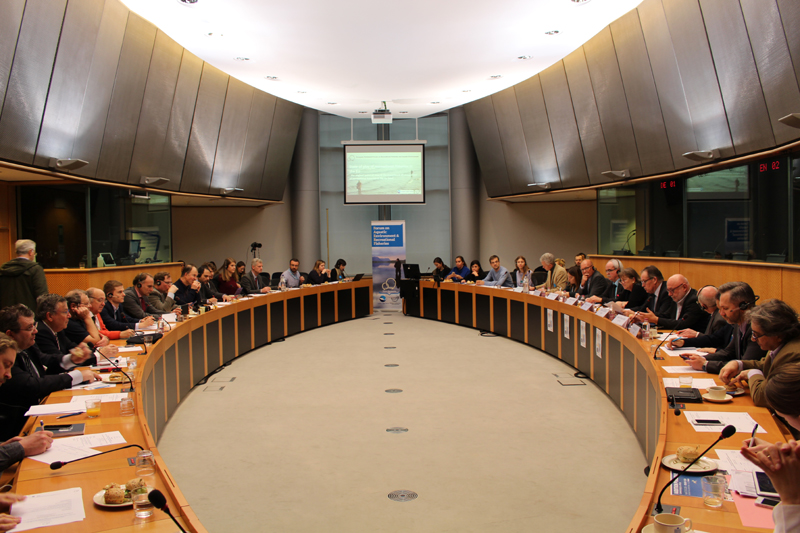
Via the Forum, the recreational fisheries sectorhas provided input to a number of important files such as the Multiannual management plans, the Regulation on Fisheries Control, the Regulation on Technical Measures, the European Maritime and Fisheries Fund and the Data Collection Framework Regulation.
The RecFishing Forum has been instrumental in raising the profile of the recreational fisheries sector in the European Parliament and to acknowledge that recreational fishing is an important and low-impact activity that generates many socio-economic benefits and jobs in coastal, rural and remote areas.
Through the Forum’s members and supporters, the interests of 25 million EU citizens participating in recreational fishing activitiesreceived the attention they deserve. Recreational fisheries are now better taken into account in EU legislation on relevant issues such as fish stocks management, fisheries technical measures, protection of biodiversity, improvement of the water quality, fostering the rural and coastal regions’ development through fishing tourism, etc. Furthermore, the information and data exchanged during the RecFishing Forum’s meetings have been useful to MEPs in their legislative work. The RecFishing Forum’s members and supporters have promoted some important initiatives during the past mandate, such as a pilot project to implement a control scheme for recreational catches of sea bass that will be fundamental in establishing better management and control measures for this iconic species and a European Parliament Resolution on the state of play of recreational fisheries in the European Union that provides a good overview of the importance of the sector and calls for its inclusion in the Common Fisheries Policy.
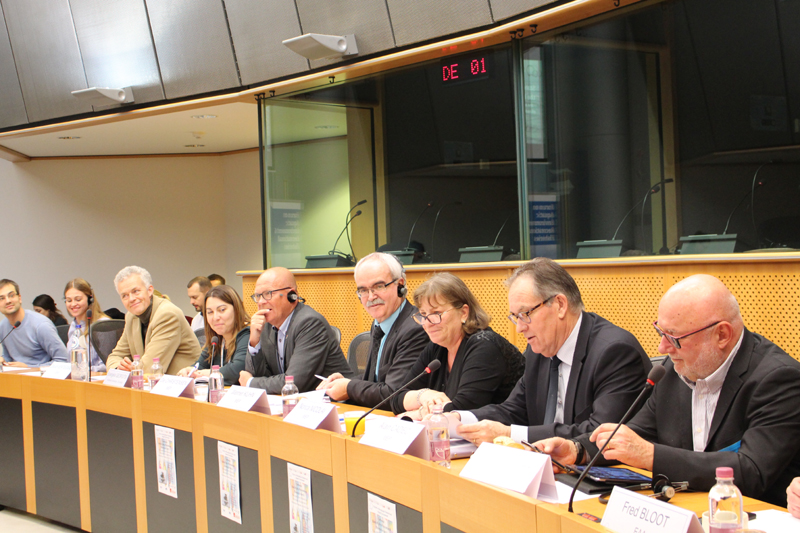
Priorities for the next five years
The RecFishing Forum will continue to provide high-level expertise to EU policy-makers on relevant issues and to give input to the legislative texts that have a direct impact on the aquatic environment, on the fish stocks and on the angling experience.
Its main priority in the next term (2019 – 2024) will be to achieve a full and fair recognition of the recreational fisheries sector, on an equal footing with the other sectors exploiting fish stocks. A fair and proper inclusion of the recreational fisheries sector in the Common Fisheries Policy would bring additional and more reliable catch and socio-economic data, which are needed by the policy and decision makers to make informed decisions about access to fishing areas and fish stocks and to ensure the sustainable exploitation of fish stocks in the EU.
The Forum remains committed to bring to the attention of European policy and decision makers the key topics of interest of the recreational fishing community such as the conservation of vulnerable fish species (European eel, seabass, Danube salmon, Baltic cod, etc.), the importance of data collection for recreational fisheries, the implementation of the Water Framework Directive, the protection of European rivers and the promotion of recreational fishing tourism.
Contact:
Telephone: +32 (0) 474 63 52 78
Email: thibault@eaa-europe.eu
Twitter: @RecFishingEP
 European Parliament Forum on Recreational Fisheries and Aquatic Environment Events

25 January 2018: State of play of recreational fisheries in the EU
European Parliament Forum on Recreational Fisheries and the aquatic environment –
EVENTS
The European Parliament Forum on Recreational Fisheries and Aquatic Environment – also known as the RecFishing Forum – organises regular policy and discussion events with the aim to increase the contacts and communication between MEPs and their 25 million angling constituents. This forum – serving as a discussion platform – addresses several important topics related to the European Parliament’s agenda with regard to recreational fisheries.
This network of MEPs, scientists, field-experts, etc. has led to positive outcomes for the recreational fisheries sector and enabled a constructive contribution of the sector to EU fisheries and environmental policies.
On this section, you can find information about past and upcoming Recfishing events*, including agendas, experts’ presentations and detailed event reports. These reports serve as valuable resources, capturing the key takeaways and highlights of the discussions held.
* These events are organised by the European Parliament Forum on Recreational Fisheries and Aquatic Environment and supported by the European Anglers Alliance (EAA) and the European Fishing Tackle Trade Association (EFTTA).
Save the date!
A toast to reel sustainable fisheries
Co-chaired by MEP Michal Wiezik & MEP Sofie Eriksson
MEP Salon, European Parliament (Brussels)
18:00 – 20:00
On 13 November 2024, the Forum on Recreational Fisheries and Aquatic Environment is organising a Cocktail event in the MEP Salon of the European Parliament (Brussels) to celebrate the official relaunch of the Forum for the 2024 – 2029 EU political mandate.
Introduction and welcome remarks will be provided by MEP Michal Wiezik (Renew Europe, Slovakia) focusing on the socio-economic and environmental benefits added by the EU’s Recreational Fisheries sector and its essential link with Members of the European Parliament under the Forum’s framework.
To wrap up the official section, Mark Owen, President of the European Anglers Alliance (EAA), and Gerard Bakkenes, Chair of the European Fishing Tackle and Trade Association (EFTTA), will outline the primary challenges facing the recreational fisheries sector over the next five years and discuss how angling can contribute to further economic growth.
After the opening segment, the Forum on Recreational Fisheries and Aquatic Environment invites all MEPs, parliamentary assistants, and relevant stakeholders in the fisheries field to engage with representatives from the European Anglers Alliance (EAA) and the European Fishing Tackle and Trade Association (EFTTA).
All interested stakeholders and policy makers are welcome!
Places are limited and will be attributed on a first arrived-first served basis.
CLICK HERETO READ THE DRAFT AGENDA
CLICK HERE TO READ THE PRESS RELEASE
The European Parliament Forum on Recreational Fisheries and Aquatic Environment is supported by the European Anglers Alliance (EAA)and the European Fishing and Tackle Trade Association (EFTTA) and serves as an informal discussion group in the European Parliament aiming at establishing a direct connection between MEPs and more largely the EU institutions and the recreational fishing community.
More information: thibault@eaa-europe.eu
CONFERENCE
EU Fisheries Policies reviewed:
“Recognizing the socio-economic importance of recreational fisheries”
European Parliament (Brussels) – 08 April (18:30 – 20:00)
On 08 April our European Parliament Forum on Recreational Fisheries and aquatic environment is organising its first policy event of 2025 inside the European Parliament. The conference will be chaired by MEP André Rodrigues and will take place in the European Parliament in Brussels from 18:00 to 19:30 (timing under embargo).
CLICK HERE TO READ THE REPORT
CLICK HERE TO READ THE PRESS RELEASE
CLICK HERE TO READ THE AGENDA
About the event
In 2017, research by the European Parliament showed that every year, millions of Europeans go fishing recreationally at sea, generating at least an annual total economic impact of 10.5 billion euro and supporting 100,000 FTE jobs in Europe. Not only angling provides social and health benefits, it also serves as an economic driver for Europe’s coastal communities.
Despite more regulations from EU policy instruments like the Fisheries Control Regulation, the 2017 research report is the only thorough source on the recreational fisheries sector. This report is now outdated due to the rise in angling’s popularity after the COVID pandemic.
The European Commission is evaluating the Common Fisheries Policy (CFP) and developing a European Ocean’s Pact. This RecFishing Forum event will explain why the recreational fisheries sector should be included as a full stakeholder in EU Fisheries policies. The event will highlight the benefits of integrating marine recreational fisheries into the CFP and showcase successful examples from other countries. The presentations will be followed by a panel discussion with EU institutions and stakeholders’ representatives.
Presentations
The presentations used by our speakers during the event are accessible here:
About the Forum
The European Parliament Forum on Recreational Fisheries and Aquatic Environment is supported by the European Anglers Alliance (EAA) and the European Fishing and Tackle Trade Association (EFTTA) and serves as an informal discussion group in the European Parliament aiming at establishing a direct connection between MEPs and more largely the EU institutions and the recreational fishing community.
More information: thibault@eaa-europe.eu
MOVIE SCREENING & POLICY DEBATE
“A Baltic Salmon requiem – FREE FALLING”
co-chaired by MEP Niclas Herbst (EPP, Germany)
European Parliament – Altiero Spinelli (3F383)
On 04 November 2025, the Forum on Recreational Fisheries and Aquatic Environment organises the movie screening & policy debate on Emilie Björkman’s movie “A Baltic salmon requiem – FREE FALLING”.
Download the event’s agenda here
Download the event’s PRESS RELEASE here
Download the event’s FINAL REPORT here
This event will highlight the urgent challenges facing the Baltic Sea ecosystem, its dependent species such as the wild salmon and the many communities depending on the good husbandry of our aquatic ecosystems! It is organised in the context of the European Commission’s proposal to amend the Baltic Sea Multiannual Plan (MAP) and the overall worrying situation of our seas and rivers.
Recreational fisheries are a major stakeholder on this topic, generating an annual economic revenue of €1.917 million EUR and support approximately 15,656 full-time equivalent (FTE) jobs, all with sustainable activities in the region’s marine & fresh waters. To highlight the EU recreational fisheries sector’s point of view, the EU angling community’s and the views of the many businesses depending on the angling experience, the European Parliament Forum on Recreational Fisheries and aquatic environment is organising the movie screening of Emilie Björkman’s documentary “a Baltic salmon requiem – FREE FALLING”.
🎬 The screening will be followed by a panel discussion featuring representatives from EU institutions and key stakeholders, including the movie director Emilie Björkman.
5 extra years of the RecFishing Forum: main achievement and future priorities

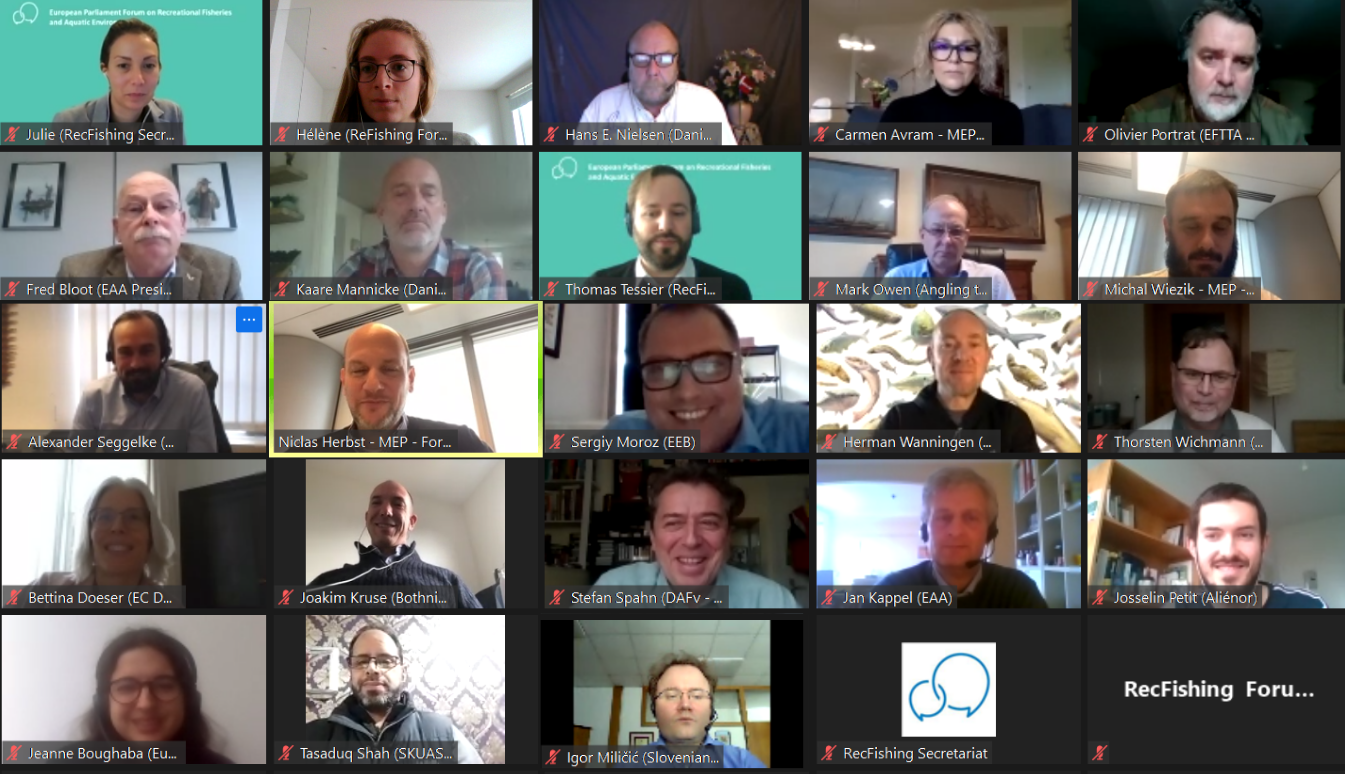
Contact:
Thibault Van Lierde
Telephone: +32 (0) 474 63 52 78
Email: thibault.vanlierde@recfish.eu
Twitter: @RecFishingEP
European Parliament Forum on Recreational Fisheries and Aquatic Environment – events 2019 – 2024 mandate
11 October 2023 – Rethinking the allocation of fisheries catches for fairer and more sustainable decisions
25 April 2023 – More big fish in the Sea! Questioning the MSY paradigm for a sustainable long-term marine fisheries management
30 November 2022 – Biodiversity protection and restoration: the contribution of the recreational fisheries sector
23 March 2022 – Exploring the inclusion of marine recreational fisheries in the Common Fisheries Policy (Videoconference)
07 September 2021 –Climate change and recreational fisheries (Videoconference)
20 April 2021 – Objective 30%: why involving recreational anglers is key for the success of Marine Protected Areas (Videoconference)
28 October 2020 – Biodiversity and hydropower: a Green Deal for migratory fish? (Videoconference)
16 July 2020 – How can angling contribute to the recovery of the EU tourism sector? (Videoconference)
19 February 2020 – Recreational fisheries in the EU: state of play, governance, perspectives
26 November 2019 – Relaunch Cocktail of the RecFishing Forum for its second mandate!
Videos
25 years of the European Anglers Alliance – What do we stand for?
Please check our video “The end of the river’ and subscribe to our channel: